With the release of 'Ant-Man', we're now in a situation where enough Marvel movies have been released that you can have entire sets of sub-preferences based on the specific characters, styles and creative teams involved, just like you can with the comics. We're sitting on an even dozen movies right now, after all, and it's no longer just a case of, "'Iron Man 2' did/didn't live up to the first one," or "'Avengers' is clearly the best." So, with the caveat that this could change at any time based on rewatching or new releases or just my mood that day, here's where I think the current state of the Marvel movies are, from "worst" to best.
12. Incredible Hulk. This, to my mind, is pretty much the bar that Marvel movies need to clear. It's not a bad film by any means: The acting is good, if functional; the script is coherent and hangs together as a story, albeit a functional one; and the action sequences, while uninspired, are well-shot and drive the plot. However, you'll clearly note words like "functional" and "uninspired" in the above description--this is such a conscious attempt to steer clear of the marmite visual stylings of Ang Lee's 'Hulk' movie and play it safe that it winds up with no particular character of its own. It's not bad, but every other Marvel movie has aspired to be better, so it drops to the bottom by default.
11. Iron Man 3. Yeah, that's right, not 'Iron Man 2', 'Iron Man 3'. The third movie, while certainly filled with a lot of flair and action and humor and a really great concept for the Mandarin that examines the "evil foreigner" trope he emobies, suffers from a slightly saggy stretch in the middle where Tony Stark is hanging around with a cute kid and feeling self-doubt, and more importantly from a lack of introspection on Tony's part. Yes, that's kind of a central fault to Tony's character--he's never really introspective, being narcissistic to the point of solipsism--but it would have been nice if the film had drawn a clearer moral line between Tony and Aldrich Killian. As it is, it feels uncomfortably like Tony is primarily fighting the Mandarin for breaking his toys.
10. Thor. This one could have fallen into the same pit as 'Incredible Hulk', if not for a really talented cast that elevates every single moment above what it should be. Chris Hemsworth imbues Thor with a puppy-like charm that leavens his character's arc and makes him sympathetic despite his bad decisions, and Tom Hiddleston underplays Loki in a way that really gives the character extra dimensions and makes him less a villain than a protagonist in a conflicting narrative. Even the supporting cast makes the most of their roles, with Kat Dennings and Stellan Skarsgard walking away with scenes that they're barely in. (Poor Natalie Portman gets utterly wasted on this script, but that's been a problem with Jane Foster for ages. As a legacy character from an era where sexism was rampant, she doesn't really have much to her beyond "Thor's love interest", despite decades of work to try to change that.)
9. Iron Man 2. Much better than anyone gives it credit for. Mickey Rourke is magnetic as Whiplash, especially in the middle section of the movie where the plot is scattering in all directions (and I think this was a conscious artistic choice designed to emphasize Tony's feelings of loss of control as his various personal crises all converge and the sharks begin to circle). Scarlett Johannson makes her debut here as Black Widow, and while she doesn't get as much to do as she later will, she's great in her role here. Don Cheadle is an instant upgrade as War Machine, and Sam Rockwell redeems himself for 'Hitch-hiker's Guide to the Galaxy'. (Oh, and the Garry Shandling scenes take on a whole new meaning in retrospect...)
8. Ant-Man. New boy! It's really a thing of parts, which limits it somewhat. On the one hand, the human drama is kind of pat and uninteresting, despite the actors' attempts to breathe life into it; of course Scott Lang is going to rise above his vaguely-altruistic criminalish past and defeat Yellowjacket, and of course Hank Pym is going to achieve rapprochement with his estranged daughter. (As for the love interest, it's so perfunctory that it literally takes place off-screen.) But once Ant-Man shrinks, suddenly you realize that this is a super-power that screams with interesting possibilities. From literally hanging onto the grooves in a record to surfing a cluster of ants along a water-pipe to the final climactic battle that turns a little girl's bedroom into an epic landscape, the shrinking scenes show that Ant-Man deserves a movie.
7. Thor: The Dark World. It shares the flaws of its predecessor (a generic fantasy concept) but in lesser measures, while improving on all of the virtues of the first 'Thor'. Hemsworth is freed from the predictable "brash jerk becomes humbled and learns virtue" arc of the first film, and is allowed to really inhabit his character. Hiddleston's Loki is fascinatingly mercurial, following his own unpredictable nature and giving astonishing depth to the villain of the past two movies. Christopher Eccleston is wasted, but the final battle is a dynamic set-piece that really showcases imagination and cleverness rather than just two people hitting each other. And it's sweet and charming, too.
6. Iron Man. The face that launched a thousand ships. This one still holds up, primarily because Robert Downey Jr takes an immensely flawed character and makes him sympathetic purely through the force of his charisma. His Tony Stark is arrogant, foolish, oblivious to the human cost of the decisions that keep him in his billionaire lifestyle...and then, when everything is taken away from him, we see that underneath all that he is a man with a strong moral sensibility and a belief that he can truly make the world a better place. Tony Stark wants to solve all the world's problems, and the hubris of that melds with the heroism of it to create a character that's the keystone of the Marvel Cinematic Universe.
5. Captain America: The First Avenger. I truly believe that this was God's gift to Joe Johnston. I really feel, deep down, like God saw 'The Rocketeer' and said, "This is a charming, clever, inventive, well-realized period piece that captures everything that was wonderful about the era in which it was set...and nobody saw the damn thing in theaters. That's just wrong. I'm going to give you the chance to do it all over again, with a more iconic hero and a bigger budget and the promotional muscle behind it to make it the hit you deserve." And that was 'Captain America: The First Avenger'. A love letter to the heroes of World War II, a charming and lively adventure story, and oh yeah, Chris Evans absolutely nails Steve Rogers. And we get Hayley Atwell as Agent Carter, a role so good she's still doing it.
4. Avengers: Age of Ultron. We're getting into some rarified heights, here. Everything from about #6 on up is a personal favorite of mine, and so I will make it clear that the fact that there are three other Marvel movies better than 'Age of Ultron' should not be taken as an indictment of the movie. It is a movie that's working on a lot of levels, as an exploration of the characters and as set-up for Phase Three of the Marvel Cinematic Universe. And it does all that without sacrificing its own plot, mainly thanks to James Spader's turn as a reckless, almost-stoned apocalyptic villain whose bemusement at the antics of the human race would be comical if he didn't plan to destroy us for it. All that and a fight scene so good they have to go into slo-mo for it.
3. Guardians of the Galaxy. Big, dumb, goofy fun. It's a quirky comedy about a group of misanthropes and loners who wind up liking each other, it's the bizarre and hilarious caper movie that 'Ant-Man' wishes it was, and it's also a cosmic space opera in the vein of 'Star Wars'. All at once, almost overlapping each other. There are certainly better films out there, but there's not many that are as much fun to watch.
2. Captain America: The Winter Soldier. If I were to be honest, I'd admit that this is the best of the Marvel movies. It's got amazing performances from all of the Marvel regulars and some great work from Robert freaking Redford, it's got stellar action sequences, and it's got a script that really does take a courageous stance on the "War Against Terror" that didn't so much stop when Bush left office as get swept under the carpet. Plus, it's a very bold movie in terms of what it does to the metastory, and while I'm someone who frequently complains when metastory is invoked as a reason to love something, it's okay when it would be an absolutely amazing movie anyway that also happens to take the gutsy step of demolishing SHIELD and forcing everyone in the Marvel Universe to re-evaluate their position in events. It really is the best movie. But...
1. Avengers is the movie I've been waiting for since I was eight years old. It is Captain America, Iron Man, Thor, Black Widow, Hawkeye and the Hulk all meeting for the first time and teaming up against the threat of Loki. It is the movie that had the most work to do--simply convincing people that the stars of three films with such disparate styles belonged in the same room together was its own massive undertaking, to say nothing of rehabilitating the Hulk after two underwhelming movies, giving the Black Widow the characterization she deserved in the absence of her own movie, making Hawkeye a believable superhero (although let's face it, most of the heavy lifting there was done in the sequel). On top of all that, it had an absolutely amazing battle sequence that raised expectations for pretty much every subsequent action movie, Marvel or otherwise. And it hit every single one of those notes perfectly. So while there may be reasons to recommend 'Winter Soldier' as a better movie, this is the Marvel film I love the most...and probably always will.
Monday, July 20, 2015

Friday, July 10, 2015
Why I Love Tigra (And Hate Almost Everything That Was Ever Done With Her)
For those of you unfamiliar with Tigra, she's...well, she's pretty darned awesome. She's part of a late-Stan Lee wave of comics created to appeal to girls, because the romance genre was dying and nothing was really cropping up to take its place. So Stan, in conjunction with pretty much everyone in Marvel at the time because this was late-period Stan Lee and he really just came up with loose ideas and handed them off to people, came up with characters like "Shanna the She-Devil" and "She-Hulk" and "The Cat", and let them loose on Marvel. The Cat, who later got actual cat powers under Tony Isabella, was an explicitly-coded feminist crimefighter who was actually given the first name Greer in what I have to believe is a shout of, "Hey everybody! Germaine Greer, please give us likes on whatever the 1972 equivalent of Facebook is!"
She was cool when she was the Cat, and she became even cooler and more awesome when she became an actual cat person with claws and fangs and started calling herself Tigra. Feminist cat-woman who was a walking Cuisinart to supervillains? Yeah, sign me up! What kind of awesome adventures did she have?
Well, for starters she got literally collared by Kraven the Hunter and mind-controlled into fighting Spider-Man. So there's that. Yeah. Feminist hero, controlled by the alpha-malest of alpha male supervillains with a literal collar around her neck because that's not symbolic of anything, rescued by a male superhero. Okay, that's not, y'know, awkward. What else?
Well, she did join the Avengers! Yay! Unfortunately, writer Steve Englehart (who, you may recall, also wrote a storyline for the Fantastic Four and its spin-offs where Ben Grimm's girlfriend, the new Ms Marvel, was sexually assaulted and became a misandrist who brutalized male supervillains) wrote a story where her "cat side" was taking over, causing her to (among other things) literally rub up against her teammates all the time in search of affection. So that's a thing that happened.
But Englehart had her overcome it through cat-person magic! And she even got a tail, which looked really good on her. Yay for her being realized as a more complete character and ditching a weird slut-shaming storyline where her nature forces her to be promiscuous!
Oh. It appears that John Byrne took over as writer and had her revert to her feline nature even more strongly to the point where she literally turned into a mindless, feral beast and Hank Pym shrunk her down and kept her in a cage so she wouldn't hurt anyone. John Byrne, same guy who worked on the Kraven story. And who made a big deal about Sue Richards "demolishing" straw-woman feminists by telling them she was proud to be a homemaker. Taking an explicitly coded feminist character and having a male character best known at the time for spousal abuse literally keep her in a cage.
But she did eventually recover from that, and went off to have adventures in space for a while. So that's good, then, right? And she even played a major role in an Avengers crossover, rescuing the whole team because the Kree underestimated her as...the weakest member of the team...okay, look, given everything I've summed up above, this is clearly not the worst thing that anyone's ever done with the character, but..."the weakest member of the team"? Were Hawkeye, Mockingbird, Captain America, the Falcon, and pretty much every other Avenger who's not inhumanly agile, strong, and capable of rending flesh with their retractable talons off that day?
But at the end of that crossover, she came back to Earth and rejoined the Avengers in their post-Civil War, everyone's an Avenger because not being an Avenger would be illegal phase. She served as an Avenger with distinction, except that she got mind-controlled by the Puppet Master and used as one of his "elite guards" who were all brainwashed women. At least this time she got rescued by Ms Marvel instead of a dude again.
It was around here that she started dating Hank Pym, who let's not forget is primarily remembered for his spousal abuse and who writer Brian Michael Bendis is on the record as thinking of as a terrible human being. But it was a Skrull impersonator, so that's alright then? I guess?
Oh, and then a bunch of supervillains broke into her apartment and beat her savagely, and videotaped it to show other superheroes what would happen to them if they resisted the Hood's gang.
Goddammit, comics.
While each individual event in this history can be explained away, and while there are certainly other stories not on this list that have treated the character well (I liked the way she was used in Marvel Adventures, even if I was a little uncomfortable at seeing her turned into a naive young superhero taken under Wolverine's wing--hey, it's still better than anything Bendis did with her) it's hard to escape the fact that when you do a pattern analysis of Tigra's history in comics, it's very clear that she's a character who started out explicitly, textually feminist and was treated very badly in subsequent stories by writers who've seemed to have issues with women in general. This is not to say that Byrne, Englehart, Bendis et al have literally been using a feminist character as a punching bag because they want to work out some of their aggressions about feminism in a fictional space, but damn does it hint strongly at it.
I would like Tigra to be used better. Better and more often, because I think she's awesome and could headline her own book and I'm not just saying that because I love cats and I love feminists and she's both in one awesome package, but mainly better. Less sexualized, to the extent that you can desexualize a character who wears a bikini (for the record, I don't think that's sexist, because it's a long-established and entirely sensible trope of the genre that furry characters of all genders wear less clothing because they have fur), and certainly less the subject of male subjugation and sexualized violence. I think this is a doable goal, and I think that anyone using Tigra should think on this carefully before they decide what to do with her, because I really don't want to have to update this in a few years' time.
She was cool when she was the Cat, and she became even cooler and more awesome when she became an actual cat person with claws and fangs and started calling herself Tigra. Feminist cat-woman who was a walking Cuisinart to supervillains? Yeah, sign me up! What kind of awesome adventures did she have?
Well, for starters she got literally collared by Kraven the Hunter and mind-controlled into fighting Spider-Man. So there's that. Yeah. Feminist hero, controlled by the alpha-malest of alpha male supervillains with a literal collar around her neck because that's not symbolic of anything, rescued by a male superhero. Okay, that's not, y'know, awkward. What else?
Well, she did join the Avengers! Yay! Unfortunately, writer Steve Englehart (who, you may recall, also wrote a storyline for the Fantastic Four and its spin-offs where Ben Grimm's girlfriend, the new Ms Marvel, was sexually assaulted and became a misandrist who brutalized male supervillains) wrote a story where her "cat side" was taking over, causing her to (among other things) literally rub up against her teammates all the time in search of affection. So that's a thing that happened.
But Englehart had her overcome it through cat-person magic! And she even got a tail, which looked really good on her. Yay for her being realized as a more complete character and ditching a weird slut-shaming storyline where her nature forces her to be promiscuous!
Oh. It appears that John Byrne took over as writer and had her revert to her feline nature even more strongly to the point where she literally turned into a mindless, feral beast and Hank Pym shrunk her down and kept her in a cage so she wouldn't hurt anyone. John Byrne, same guy who worked on the Kraven story. And who made a big deal about Sue Richards "demolishing" straw-woman feminists by telling them she was proud to be a homemaker. Taking an explicitly coded feminist character and having a male character best known at the time for spousal abuse literally keep her in a cage.
But she did eventually recover from that, and went off to have adventures in space for a while. So that's good, then, right? And she even played a major role in an Avengers crossover, rescuing the whole team because the Kree underestimated her as...the weakest member of the team...okay, look, given everything I've summed up above, this is clearly not the worst thing that anyone's ever done with the character, but..."the weakest member of the team"? Were Hawkeye, Mockingbird, Captain America, the Falcon, and pretty much every other Avenger who's not inhumanly agile, strong, and capable of rending flesh with their retractable talons off that day?
But at the end of that crossover, she came back to Earth and rejoined the Avengers in their post-Civil War, everyone's an Avenger because not being an Avenger would be illegal phase. She served as an Avenger with distinction, except that she got mind-controlled by the Puppet Master and used as one of his "elite guards" who were all brainwashed women. At least this time she got rescued by Ms Marvel instead of a dude again.
It was around here that she started dating Hank Pym, who let's not forget is primarily remembered for his spousal abuse and who writer Brian Michael Bendis is on the record as thinking of as a terrible human being. But it was a Skrull impersonator, so that's alright then? I guess?
Oh, and then a bunch of supervillains broke into her apartment and beat her savagely, and videotaped it to show other superheroes what would happen to them if they resisted the Hood's gang.
Goddammit, comics.
While each individual event in this history can be explained away, and while there are certainly other stories not on this list that have treated the character well (I liked the way she was used in Marvel Adventures, even if I was a little uncomfortable at seeing her turned into a naive young superhero taken under Wolverine's wing--hey, it's still better than anything Bendis did with her) it's hard to escape the fact that when you do a pattern analysis of Tigra's history in comics, it's very clear that she's a character who started out explicitly, textually feminist and was treated very badly in subsequent stories by writers who've seemed to have issues with women in general. This is not to say that Byrne, Englehart, Bendis et al have literally been using a feminist character as a punching bag because they want to work out some of their aggressions about feminism in a fictional space, but damn does it hint strongly at it.
I would like Tigra to be used better. Better and more often, because I think she's awesome and could headline her own book and I'm not just saying that because I love cats and I love feminists and she's both in one awesome package, but mainly better. Less sexualized, to the extent that you can desexualize a character who wears a bikini (for the record, I don't think that's sexist, because it's a long-established and entirely sensible trope of the genre that furry characters of all genders wear less clothing because they have fur), and certainly less the subject of male subjugation and sexualized violence. I think this is a doable goal, and I think that anyone using Tigra should think on this carefully before they decide what to do with her, because I really don't want to have to update this in a few years' time.
Tuesday, July 07, 2015
CONvergence Round-Up
Sorry about the lack of posting last week, but I was at CONvergence last week. If you've ever been to a con, you're probably already nodding your head knowingly (if you haven't, may I recommend CONvergence? It's very nice.) Trying to do anything apart from attending a convention while you're at a convention is a nightmare, because the convention has so many attractions and events that you can't even do everything you want to do there, let alone everything else. Just feeding the cats was a challenge, so blogging kind of went by the wayside.
The convention itself was wonderful, as always--one of the things I adore about CONvergence is that it has a very robust harassment policy combined with a volunteer-driven ethos that helps to promote good con-oriented behavior. CONvergence is an entirely volunteer-run convention, and everyone is encouraged to participate before, during and after the convention in making it run smoothly; in my experience, this cuts down greatly on bad behavior from attendees, because the person staffing the Operations desk or serving food at the Consuite might be you tomorrow. It helps make everyone more empathetic to the challenges that crop up for even the best-run conventions.
Part of that means that my convention started the day before the con; I helped out with badge pickup over in Registration. That's always fun for me because I get to see, over the course of that day, almost all of the 6000 attendees, and chat with them (albeit briefly). Meaning if there are any old friends attending (which there usually are), I at least get to say hello.
The next day I mostly spent with my child--we attended a panel on YA literature, wandered the dealers' room, had consuite food, and learned the history of the extremely short-lived Sid and Marty Krofft theme park. (It cost 22 million dollars and closed after six months due to a combination of bad location and bad logistics.) After I put the kid to bed, I wandered down and watched a collection of trailers at Cinema Rex (the con's movie room), which included a 'Suicide Squad' trailer so bad I'm literally hoping it's a fan trailer.
The next day, I live-tweeted the "Nobody Will Pay You If You Don't Ask" panel, about how to monetize the work you put into your hobbies (it was mostly about crafting, but there was some good writing info too) and then did my own panels, "Marvel Movie Round-Up" and "Cheesiest Post-Apocalyptic Movies". I think both went well, although I'd love to hear what other people thought in the comments if you were there and also read my blog. (Unlikely, but you never know!) After that, I hooked back up with Kidlet for a Squirrel Girl panel and then took him back to the room to sleep. Then I picked up my wife (who had to work both Thursday and Friday) and we came back to take in the extremely funny Killer B's Improv Show. They strip the soundtrack from random film clips (ones the panelists have not seen) and then the comedians and musicians provide live music and improvised dialogue to them. It was very funny, and I even recognized one of the movies they did.
Saturday, my wife took a well-deserved "me time" day and I took our child along to the "Worst of Doctor Who" panel (not quite as funny as it sounded, but Joseph Scrimshaw was good) and to my "Doctor Who Season 8 Round-Up" panel, which I think went well but again feedback is always nice. Then we saw a special presentation by the University of Minnesota's Raptor Center--they come every year and do a live bird show with rescued wild birds of prey. This year we got a saw-whet owl, a great horned owl, a kestrel, a turkey vulture, a peregrine falcon, and a bald eagle (on the Fourth of July, too!) We got seats right next to the crates, so we were about two feet away when they took out the birds. It was absolutely amazing.
After that, Kidlet went to spend some Mom time and I attended the Agents of SHIELD panel, which I enjoyed. The panelists had a lot of interesting things to say about the show, they enjoyed it (it's always frustrating when you get a panel where someone's uninformed, but it's much worse when you get to a "fan panel" where nobody's actually a fan) and the audience was great too. We were going to do another panel with the kid at that point, on foley, but he told us he was feeling pretty maxed so we went back to the room with him and then headed out to meet up with an old friend for dinner. (It's around here that I clarify that we were part of a large group, and that there was an adult in the room at all times. Just in case you worried.)
Saturday ended with two absolutely perfect panels; "I'm Sorry, I Haven't a Clue" involved Paul Cornell and Lee Harris doing a live version of the classic BBC radio show, which was so funny I almost literally fell off of my chair (I propped myself up against the wall), and "Cult Classics: So Bad It's Good" involved a discussion of the movie 'Executive Koala' that made all of us ponder the immortal question: EXECUTIVE KOALA?
Sunday was much quieter--Kidlet and I saw 'The Lego Movie' together, and then I went and did some volunteering to close out the con. It was, as always, a wonderful experience, and I'm already looking forward to next year!
The convention itself was wonderful, as always--one of the things I adore about CONvergence is that it has a very robust harassment policy combined with a volunteer-driven ethos that helps to promote good con-oriented behavior. CONvergence is an entirely volunteer-run convention, and everyone is encouraged to participate before, during and after the convention in making it run smoothly; in my experience, this cuts down greatly on bad behavior from attendees, because the person staffing the Operations desk or serving food at the Consuite might be you tomorrow. It helps make everyone more empathetic to the challenges that crop up for even the best-run conventions.
Part of that means that my convention started the day before the con; I helped out with badge pickup over in Registration. That's always fun for me because I get to see, over the course of that day, almost all of the 6000 attendees, and chat with them (albeit briefly). Meaning if there are any old friends attending (which there usually are), I at least get to say hello.
The next day I mostly spent with my child--we attended a panel on YA literature, wandered the dealers' room, had consuite food, and learned the history of the extremely short-lived Sid and Marty Krofft theme park. (It cost 22 million dollars and closed after six months due to a combination of bad location and bad logistics.) After I put the kid to bed, I wandered down and watched a collection of trailers at Cinema Rex (the con's movie room), which included a 'Suicide Squad' trailer so bad I'm literally hoping it's a fan trailer.
The next day, I live-tweeted the "Nobody Will Pay You If You Don't Ask" panel, about how to monetize the work you put into your hobbies (it was mostly about crafting, but there was some good writing info too) and then did my own panels, "Marvel Movie Round-Up" and "Cheesiest Post-Apocalyptic Movies". I think both went well, although I'd love to hear what other people thought in the comments if you were there and also read my blog. (Unlikely, but you never know!) After that, I hooked back up with Kidlet for a Squirrel Girl panel and then took him back to the room to sleep. Then I picked up my wife (who had to work both Thursday and Friday) and we came back to take in the extremely funny Killer B's Improv Show. They strip the soundtrack from random film clips (ones the panelists have not seen) and then the comedians and musicians provide live music and improvised dialogue to them. It was very funny, and I even recognized one of the movies they did.
Saturday, my wife took a well-deserved "me time" day and I took our child along to the "Worst of Doctor Who" panel (not quite as funny as it sounded, but Joseph Scrimshaw was good) and to my "Doctor Who Season 8 Round-Up" panel, which I think went well but again feedback is always nice. Then we saw a special presentation by the University of Minnesota's Raptor Center--they come every year and do a live bird show with rescued wild birds of prey. This year we got a saw-whet owl, a great horned owl, a kestrel, a turkey vulture, a peregrine falcon, and a bald eagle (on the Fourth of July, too!) We got seats right next to the crates, so we were about two feet away when they took out the birds. It was absolutely amazing.
After that, Kidlet went to spend some Mom time and I attended the Agents of SHIELD panel, which I enjoyed. The panelists had a lot of interesting things to say about the show, they enjoyed it (it's always frustrating when you get a panel where someone's uninformed, but it's much worse when you get to a "fan panel" where nobody's actually a fan) and the audience was great too. We were going to do another panel with the kid at that point, on foley, but he told us he was feeling pretty maxed so we went back to the room with him and then headed out to meet up with an old friend for dinner. (It's around here that I clarify that we were part of a large group, and that there was an adult in the room at all times. Just in case you worried.)
Saturday ended with two absolutely perfect panels; "I'm Sorry, I Haven't a Clue" involved Paul Cornell and Lee Harris doing a live version of the classic BBC radio show, which was so funny I almost literally fell off of my chair (I propped myself up against the wall), and "Cult Classics: So Bad It's Good" involved a discussion of the movie 'Executive Koala' that made all of us ponder the immortal question: EXECUTIVE KOALA?
Sunday was much quieter--Kidlet and I saw 'The Lego Movie' together, and then I went and did some volunteering to close out the con. It was, as always, a wonderful experience, and I'm already looking forward to next year!
Monday, June 29, 2015
Why I Love Zoos
I'm currently reading a book by Peter Laufer called 'Forbidden Animals', about the trade in exotic pets. It's an absolutely fascinating book so far, but one thing I do notice is that the author and several of the subjects he interviews is that they're not particularly fond of zoos. Opinions have ranged from "I hate zoos" to "zoos are nothing but misery for animals", and that's only by page 65. I doubt I'll get many complimentary statements on the subject by the end of the book.
This is far from the only time I've read uncomplimentary statements about zoos. They used to upset me, but I've come to understand that my experience of zoos is very different from that of the people like Laufer and the people he talked to. I've been very lucky in that my zoo memories come from a much happier place, both for myself and for the animals, and I do want to talk about it for a bit because I fully believe that there is a difference between being opposed to zoos in principle and being opposed to the way many zoos operate in practice.
To start, it's worth understanding that the Minnesota Zoo opened when I was three years old, less than ten miles away from my house. My parents bought a zoo membership every year for most of my childhood, which meant that admission was free, and as such they were perfectly happy to take my sisters and I to visit on a weekly basis. The exhibits have changed slightly over the years--I'm still slightly surprised at times to find komodo dragons and DeBrazza's monkeys where I vividly remember caimans and sloth bears--but I am familiar with every inch of that zoo.
This is important, because as a child I also happened to be a big fan of the books written by naturalist Gerald Durrell. Durrell was famous for his vivid, colorful accounts of the trips he took collecting animals for zoos, but he was even more famous for his decision to stop collecting animals for other zoos, which he thought were run badly and took little account of the welfare of the animals, and to start running his own zoo founded on his philosophy of what the role of a zoo should be in society.
For those of you not interested in chasing down all those links, I'll sum up. Durrell believed that the primary purpose of a zoo was to act as a habitat for animals that were endangered--a reservoir for the species in the event of extinction in the wild. He believed that it was the job of a zoo to make sure that these animals survived until they could be reintroduced to the wild as a species, and that displaying them to the public was primarily important to educate people on the role they could play in conserving nature. Keeping an animal purely for entertainment purposes was highly discouraged in his philosophy.
This filtered down to his philosophy on exhibit design. His priority, first and foremost, was the comfort of the animal. Viewing comfort of visitors wasn't even second on the list (that was ease of use for keepers). Exhibits should be as large or as small as needed to match the animals' preferred territory, and they should have areas to go if needed to get away from people. He was a pioneer in feeding animals the food that they preferred in nature, and in designing "enrichment"--activities that mimicked their natural behavior and kept them interested and engaged in daily life. (This is very different, by the way, from "animal shows". In a zoo designed according to Durrell's philosophy, animals are not asked to perform in any way, shape or form.)
The Minnesota Zoo, as long as I can remember, has been designed around those same philosophies. It is so close to Durrell's idea of a zoo that many of the exhibits are identical to the wildlife park he founded. When I go there, even today, I see happy, fulfilled animals that are not just surviving but thriving thanks to the hard work of dedicated people who put the animals' welfare first and foremost. I've been very lucky to have that as my amazing zoo all my life, and I sometimes forget that not everyone has had those experiences.
So for those of you who don't like zoos, I do understand. I hope that you follow those links and read about zoos that do treat the animals well, and I hope that we all someday reach a point where Durrell's philosophy has prevailed in the zoological world. Because a well-run zoo is really an animal's best friend.
This is far from the only time I've read uncomplimentary statements about zoos. They used to upset me, but I've come to understand that my experience of zoos is very different from that of the people like Laufer and the people he talked to. I've been very lucky in that my zoo memories come from a much happier place, both for myself and for the animals, and I do want to talk about it for a bit because I fully believe that there is a difference between being opposed to zoos in principle and being opposed to the way many zoos operate in practice.
To start, it's worth understanding that the Minnesota Zoo opened when I was three years old, less than ten miles away from my house. My parents bought a zoo membership every year for most of my childhood, which meant that admission was free, and as such they were perfectly happy to take my sisters and I to visit on a weekly basis. The exhibits have changed slightly over the years--I'm still slightly surprised at times to find komodo dragons and DeBrazza's monkeys where I vividly remember caimans and sloth bears--but I am familiar with every inch of that zoo.
This is important, because as a child I also happened to be a big fan of the books written by naturalist Gerald Durrell. Durrell was famous for his vivid, colorful accounts of the trips he took collecting animals for zoos, but he was even more famous for his decision to stop collecting animals for other zoos, which he thought were run badly and took little account of the welfare of the animals, and to start running his own zoo founded on his philosophy of what the role of a zoo should be in society.
For those of you not interested in chasing down all those links, I'll sum up. Durrell believed that the primary purpose of a zoo was to act as a habitat for animals that were endangered--a reservoir for the species in the event of extinction in the wild. He believed that it was the job of a zoo to make sure that these animals survived until they could be reintroduced to the wild as a species, and that displaying them to the public was primarily important to educate people on the role they could play in conserving nature. Keeping an animal purely for entertainment purposes was highly discouraged in his philosophy.
This filtered down to his philosophy on exhibit design. His priority, first and foremost, was the comfort of the animal. Viewing comfort of visitors wasn't even second on the list (that was ease of use for keepers). Exhibits should be as large or as small as needed to match the animals' preferred territory, and they should have areas to go if needed to get away from people. He was a pioneer in feeding animals the food that they preferred in nature, and in designing "enrichment"--activities that mimicked their natural behavior and kept them interested and engaged in daily life. (This is very different, by the way, from "animal shows". In a zoo designed according to Durrell's philosophy, animals are not asked to perform in any way, shape or form.)
The Minnesota Zoo, as long as I can remember, has been designed around those same philosophies. It is so close to Durrell's idea of a zoo that many of the exhibits are identical to the wildlife park he founded. When I go there, even today, I see happy, fulfilled animals that are not just surviving but thriving thanks to the hard work of dedicated people who put the animals' welfare first and foremost. I've been very lucky to have that as my amazing zoo all my life, and I sometimes forget that not everyone has had those experiences.
So for those of you who don't like zoos, I do understand. I hope that you follow those links and read about zoos that do treat the animals well, and I hope that we all someday reach a point where Durrell's philosophy has prevailed in the zoological world. Because a well-run zoo is really an animal's best friend.
Friday, June 26, 2015
Review: The Severed Streets
I started 'The Severed Streets', Paul Cornell's latest novel about a team of detectives who gain the second sight and can see all the magical secrets of London, right after finishing 'Ancillary Justice'. I'm already done with it. That should tell you something right there, but I will elaborate.
This is a gorgeous book. I've been following Paul Cornell's writing since the 1990s, when he was an up-and-coming young writer doing TV tie-ins for Doctor Who and teaching a generation of fans and professionals alike that "TV tie-in" doesn't have to mean "generic pastiche" (his Who novels are mostly out-of-print, but they've been adapted for audio by Big Finish and are worth a listen). His skill has always been in evoking powerful, deep emotions by forcing his characters to make meaningful choices with big risks. Oh, and for those of you who've seen 'Father's Day', his first televised Doctor Who story, you already know that his big theme is about family.
So it should come as no surprise that 'The Severed Streets' continues on in this tradition. One of the threads from his previous novel in this series, 'London Falling', comes to the forefront here as Ross, a character who discovered that her father resides in Hell, now discovers a way to bring him out of it. But as you can imagine, bringing someone out of Hell and back to the world of the living is something that is not easy, and coveted by many people...including Costain, the undercover detective for the team who learned towards the end of the novel that Hell awaits him for his sins in life. The "Get Out of Hell Free" card, and the things that both Ross and Costain are prepared to do to get it, propel the novel forward with ferocious speed.
This book also provides the first real background on the secret London the characters have stumbled into, and it's clearly something that has enough material to provide plenty of books. We see that there is a long, ancient occult tradition in London...and we also see that some very wealthy and powerful people have learned of its existence and are trying to buy their way in. The characters see first-hand how much friction this is already causing, and there's a very real sense that this is something that has the potential to get much, much worse before it gets better. If it does. (Hey, remember the Smiling Man from 'London Falling' who was orchestrating everything behind the scenes to slowly turn London into a grinding, miserable hell on earth? Yeah, he's not gone.)
All of these threads seem disconnected from the main plot at first--there's an invisible Jack the Ripper impersonator out there who kills rich white men. But Cornell does a masterful job of weaving all the disparate threads together by the end of the book in ways you don't necessarily see coming, and along the way he really puts the screws to his characters in ways that ratchet up the tension with each scene. It's a relentless book, feeling at times like a series of brutal initiation rituals for the nascent practitioners of magic, and at other times like they're making all too human mistakes. He does not pull his punches--there are some bits so intense I was almost moved to tears--but none of the big moments feel unearned. Cornell really made this universe and the people who live in it feel real, and their struggles feel touching.
Oh, and there's a celebrity cameo on page 110 or so that has to be seen to be believed.
On the whole, if you've read 'London Falling', this is everything good about that book amped up a couple more notches. If you haven't read 'London Falling', what a coincidence--I recommended that too!
This is a gorgeous book. I've been following Paul Cornell's writing since the 1990s, when he was an up-and-coming young writer doing TV tie-ins for Doctor Who and teaching a generation of fans and professionals alike that "TV tie-in" doesn't have to mean "generic pastiche" (his Who novels are mostly out-of-print, but they've been adapted for audio by Big Finish and are worth a listen). His skill has always been in evoking powerful, deep emotions by forcing his characters to make meaningful choices with big risks. Oh, and for those of you who've seen 'Father's Day', his first televised Doctor Who story, you already know that his big theme is about family.
So it should come as no surprise that 'The Severed Streets' continues on in this tradition. One of the threads from his previous novel in this series, 'London Falling', comes to the forefront here as Ross, a character who discovered that her father resides in Hell, now discovers a way to bring him out of it. But as you can imagine, bringing someone out of Hell and back to the world of the living is something that is not easy, and coveted by many people...including Costain, the undercover detective for the team who learned towards the end of the novel that Hell awaits him for his sins in life. The "Get Out of Hell Free" card, and the things that both Ross and Costain are prepared to do to get it, propel the novel forward with ferocious speed.
This book also provides the first real background on the secret London the characters have stumbled into, and it's clearly something that has enough material to provide plenty of books. We see that there is a long, ancient occult tradition in London...and we also see that some very wealthy and powerful people have learned of its existence and are trying to buy their way in. The characters see first-hand how much friction this is already causing, and there's a very real sense that this is something that has the potential to get much, much worse before it gets better. If it does. (Hey, remember the Smiling Man from 'London Falling' who was orchestrating everything behind the scenes to slowly turn London into a grinding, miserable hell on earth? Yeah, he's not gone.)
All of these threads seem disconnected from the main plot at first--there's an invisible Jack the Ripper impersonator out there who kills rich white men. But Cornell does a masterful job of weaving all the disparate threads together by the end of the book in ways you don't necessarily see coming, and along the way he really puts the screws to his characters in ways that ratchet up the tension with each scene. It's a relentless book, feeling at times like a series of brutal initiation rituals for the nascent practitioners of magic, and at other times like they're making all too human mistakes. He does not pull his punches--there are some bits so intense I was almost moved to tears--but none of the big moments feel unearned. Cornell really made this universe and the people who live in it feel real, and their struggles feel touching.
Oh, and there's a celebrity cameo on page 110 or so that has to be seen to be believed.
On the whole, if you've read 'London Falling', this is everything good about that book amped up a couple more notches. If you haven't read 'London Falling', what a coincidence--I recommended that too!
Monday, June 22, 2015
Review: Ancillary Justice
I like Terry Pratchett a lot more than I like JRR Tolkien.
I know that's an odd way to start out a review of Ann Leckie's Hugo Award-winning hard science fiction novel 'Ancillary Justice', but hear me out. The reason I like Pratchett more than Tolkien is that I always felt like Pratchett started with a story, and did about as much worldbuilding as he had to in order to explain the bits that were important to the story. Whereas Tolkien, I felt, really had much more interest in the language, history, culture, geography, et cetera, of the world he created--the story was really just a means to show it all off.
Some people love that kind of immersion. They want a world so real they can imagine inhabiting it, and can return to it every time they read the novel. Me, I'm not so much into that. I like to read a good story, and see worldbuilding only as a means to the end of telling the story you want to tell. This isn't to say I can't appreciate the craft of worldbuilding--Tolkien is a great author and I'd be a fool to say otherwise. But I know which one of the two I read for pleasure.
I think that's why, despite appreciating 'Ancillary Justice', I didn't really enjoy it all that much. There is a plot, and it's actually a very clever one. But Leckie takes a lot of time in getting to it; she's got a lot to say about the Radch, the empire that controls vast segments of the galaxy, and she wants you to really get a handle on the reality of living in the empire they've created. Vast chunks of the novel are taken up explaining customs, linguistics (yes, including the bit the book is famous for, that the default gender is "she") and politics of the Radch, long before the plot ever kicks into gear.
(It should be noted here that it probably doesn't help that half the book is an extended series of flashbacks that alternate with the main action. I can, to some extent, understand exactly why Leckie did it; the opening sequences, of the main character traveling to a distant ice planet in search of the tools of revenge against the woman who killed her...well, most of her...it's a great hook, and it would be hard to abandon it. But it does mean that there are two interweaving plotlines that both take a long time to get going, rather than one plotline that climaxes at the mid-point of the novel and another at the end.)
Still, for all I complain that I'd prefer more plot and less worldbuilding, the worldbuilding we do get is choice. The Radch has some wonderful thematic echoes of late-period Roman Empire, but there's a lot going on under the surface that's more reminiscent of the British Empire towards the end of its heyday, when people were just beginning to wake up to the idea that "loot and pillage other countries to civilize them" was not exactly the moral high ground it was once seen as. There's a lot here to reward careful reading.
There's also an excellent sci-fi conceit; the Lord of the Radch, Anaander Mianaai, is actually an intelligence spread out over multiple bodies throughout Radch space, ruling directly through thousands of host bodies (much like the main character did at one point before her core intellect was destroyed). Leckie does a lot with this concept, and every development of it is both interesting and proceeds logically from the one before. By the end, when the plot finally gets to gallop, you're definitely left wanting more.
That may, I suppose, also be seen as a weakness; this book does a lot of worldbuilding to set up the next two books that presumably will shake up the systems established here. But as I say, it is excellently-done worldbuilding, so fans of that kind of SF/F are going to have a lot to like. Me, I wasn't quite so enamored of it, but I can certainly see what all the fuss was about.
I know that's an odd way to start out a review of Ann Leckie's Hugo Award-winning hard science fiction novel 'Ancillary Justice', but hear me out. The reason I like Pratchett more than Tolkien is that I always felt like Pratchett started with a story, and did about as much worldbuilding as he had to in order to explain the bits that were important to the story. Whereas Tolkien, I felt, really had much more interest in the language, history, culture, geography, et cetera, of the world he created--the story was really just a means to show it all off.
Some people love that kind of immersion. They want a world so real they can imagine inhabiting it, and can return to it every time they read the novel. Me, I'm not so much into that. I like to read a good story, and see worldbuilding only as a means to the end of telling the story you want to tell. This isn't to say I can't appreciate the craft of worldbuilding--Tolkien is a great author and I'd be a fool to say otherwise. But I know which one of the two I read for pleasure.
I think that's why, despite appreciating 'Ancillary Justice', I didn't really enjoy it all that much. There is a plot, and it's actually a very clever one. But Leckie takes a lot of time in getting to it; she's got a lot to say about the Radch, the empire that controls vast segments of the galaxy, and she wants you to really get a handle on the reality of living in the empire they've created. Vast chunks of the novel are taken up explaining customs, linguistics (yes, including the bit the book is famous for, that the default gender is "she") and politics of the Radch, long before the plot ever kicks into gear.
(It should be noted here that it probably doesn't help that half the book is an extended series of flashbacks that alternate with the main action. I can, to some extent, understand exactly why Leckie did it; the opening sequences, of the main character traveling to a distant ice planet in search of the tools of revenge against the woman who killed her...well, most of her...it's a great hook, and it would be hard to abandon it. But it does mean that there are two interweaving plotlines that both take a long time to get going, rather than one plotline that climaxes at the mid-point of the novel and another at the end.)
Still, for all I complain that I'd prefer more plot and less worldbuilding, the worldbuilding we do get is choice. The Radch has some wonderful thematic echoes of late-period Roman Empire, but there's a lot going on under the surface that's more reminiscent of the British Empire towards the end of its heyday, when people were just beginning to wake up to the idea that "loot and pillage other countries to civilize them" was not exactly the moral high ground it was once seen as. There's a lot here to reward careful reading.
There's also an excellent sci-fi conceit; the Lord of the Radch, Anaander Mianaai, is actually an intelligence spread out over multiple bodies throughout Radch space, ruling directly through thousands of host bodies (much like the main character did at one point before her core intellect was destroyed). Leckie does a lot with this concept, and every development of it is both interesting and proceeds logically from the one before. By the end, when the plot finally gets to gallop, you're definitely left wanting more.
That may, I suppose, also be seen as a weakness; this book does a lot of worldbuilding to set up the next two books that presumably will shake up the systems established here. But as I say, it is excellently-done worldbuilding, so fans of that kind of SF/F are going to have a lot to like. Me, I wasn't quite so enamored of it, but I can certainly see what all the fuss was about.
Friday, June 19, 2015
Some Horn-Tooting!
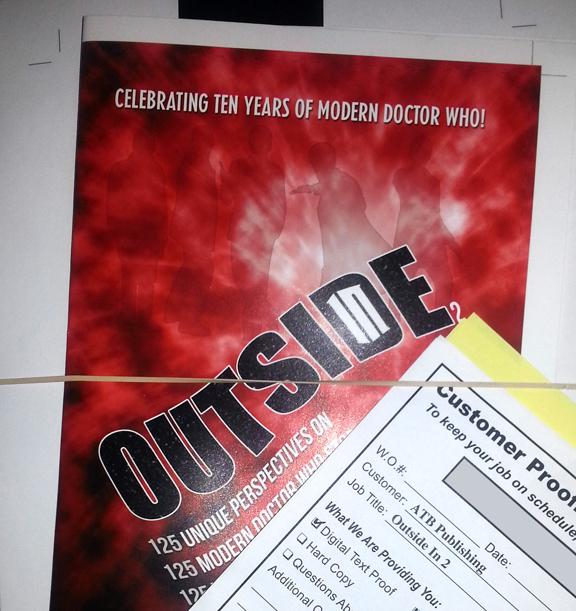
For those of you who enjoyed the original 'Outside In', which contained an essay on every story in the classic Doctor Who series by a different author for every story, the sequel is coming soon from ATB Publishing! This one will have, as you can see from the proof cover, 125 essays by 125 authors on 125 different episodes of 'Doctor Who'. I'm in there, writing about "The Christmas Invasion" and making what I think is a pretty credible case that it is not only meant to bookend "Rose", but also that it's meant to foreshadow the Tenth Doctor's descent into the Time Lord Victorious and eventual regeneration. I look forward to the book's arrival (once the madness of sorting out 125 author copies is past) and to talking about it at cons!
Tuesday, June 16, 2015
My Internet Points for the Day
A particularly sad Sad Puppy on File770 unironically stated the following:
It’s war, John; there aren’t any rules, only principles, and the only way to find even the approximate truth is by comparing the lies.
I read that statement. I actually read it a good two or three times, trying to imagine what kind of headspace it would have to have come from. I tried very hard to imagine being the kind of person--a veteran of military service, believe it or not--who could actually believe that war was waged through a series of increasingly outraged Internet blog posts, with a yearly smattering of casting ballots against the people who had committed the foul crime of being women and minorities. That this was not only a heroic action, but a significant and meaningful one. My response:
I want to frame this. Seriously, I want to frame it, light it up in neon, and take tours past it every half hour in perpetuity. “Yes,” the tour guide will say, “this is the smallest, pettiest, most unspeakably bitter and impotent statement ever uttered in support of an irrelevant, deranged and worthless cause. We have found it, and we have enshrined it here forever. Gaze upon it and know that whatever travails and trials and troubles might be present in your life, you have not been reduced to saying this on the Internet.”
I know, it's probably mean, but I want to keep it around if for no other reason than I think that sentence may provide people with comfort on bad days.
It’s war, John; there aren’t any rules, only principles, and the only way to find even the approximate truth is by comparing the lies.
I read that statement. I actually read it a good two or three times, trying to imagine what kind of headspace it would have to have come from. I tried very hard to imagine being the kind of person--a veteran of military service, believe it or not--who could actually believe that war was waged through a series of increasingly outraged Internet blog posts, with a yearly smattering of casting ballots against the people who had committed the foul crime of being women and minorities. That this was not only a heroic action, but a significant and meaningful one. My response:
I want to frame this. Seriously, I want to frame it, light it up in neon, and take tours past it every half hour in perpetuity. “Yes,” the tour guide will say, “this is the smallest, pettiest, most unspeakably bitter and impotent statement ever uttered in support of an irrelevant, deranged and worthless cause. We have found it, and we have enshrined it here forever. Gaze upon it and know that whatever travails and trials and troubles might be present in your life, you have not been reduced to saying this on the Internet.”
I know, it's probably mean, but I want to keep it around if for no other reason than I think that sentence may provide people with comfort on bad days.
Saturday, June 13, 2015
Additional Clarification to Previous Post
No, I did not intentionally arrange things so that the 'Megaforce' ad cut off where it did. As amusing as it wound up being, it was not a deliberate misrepresentation of the film to suggest that it featured Brad from Rocky Horror wearing a skin-tight jumpsuit and pointing out at the audience, saying, "Are You Man Enough For Me?"
But hey, if you want to do fanfiction about it, go for it.
But hey, if you want to do fanfiction about it, go for it.
Monday, June 08, 2015
Fame Is a Fickle Beast
The Onion AV Club has an interview with Barry Bostwick up today, part of their "Random Roles" series where they ask famous and well-respected actors about some of the more interesting parts in their long, distinguished careers. This is kind of weird for me, because my primary memory of Barry Bostwick is as the hero of the 1982 movie 'Megaforce'.
In fairness, I thought for years that it was Chuck Norris in 'Megaforce'. This is because my primary memory of 'Megaforce' is not the movie itself, but the ad for it that ran in dozens of comics when I was a kid:

There aren't any actors mentioned--it's just an ad for membership in a fan club for a movie that hadn't even come out yet, because it was the 80s and you could get away with stuff like that. The guy with the headband looked like Chuck Norris, so I assumed for years that it was a Chuck Norris movie and that it was some sort of cool live-action G.I. Joe pastiche full of awesomesplosions.
Then years later I saw it, and I realized that they must not have been able to get Chuck Norris and so they got Barry Bostwick instead and had him grow out a Chuck-style mullet and beard. Knowing what I know now about Bostwick's other parts, this has to be one of the most hilarious casting decisions in the history of cinema, but it's such a memorably goofy and terrible movie that it is my indelible association with the actor.
What I'd really like to know is if anyone else does this. Do any of my readers see Orson Welles and think, "Oh, right, Transformers!"? Or immediately jump to the conclusion that we're talking about 'Overdrawn at the Memory Bank' when we discuss Raoul Julia? Feel free to discuss your awkward actor associations in the comments!
In fairness, I thought for years that it was Chuck Norris in 'Megaforce'. This is because my primary memory of 'Megaforce' is not the movie itself, but the ad for it that ran in dozens of comics when I was a kid:
There aren't any actors mentioned--it's just an ad for membership in a fan club for a movie that hadn't even come out yet, because it was the 80s and you could get away with stuff like that. The guy with the headband looked like Chuck Norris, so I assumed for years that it was a Chuck Norris movie and that it was some sort of cool live-action G.I. Joe pastiche full of awesomesplosions.
Then years later I saw it, and I realized that they must not have been able to get Chuck Norris and so they got Barry Bostwick instead and had him grow out a Chuck-style mullet and beard. Knowing what I know now about Bostwick's other parts, this has to be one of the most hilarious casting decisions in the history of cinema, but it's such a memorably goofy and terrible movie that it is my indelible association with the actor.
What I'd really like to know is if anyone else does this. Do any of my readers see Orson Welles and think, "Oh, right, Transformers!"? Or immediately jump to the conclusion that we're talking about 'Overdrawn at the Memory Bank' when we discuss Raoul Julia? Feel free to discuss your awkward actor associations in the comments!
Monday, June 01, 2015
Awkward Question of the Day
I saw on the Gawker network that today was actually a holiday in Alabama honoring Confederate president Jefferson Davis. Now, this is the Internet, home of extraordinarily ludicrous errors perpetuated by people who only fact check things against other Internet sources that are in turn repeating the things they saw on the Internet in a colossal daisy chain of misinformation, so there's every possibility that this is nothing more than a scurrilous slander to the people of Alabama. But it certainly does illuminate a bizarre psychosocial trend--people who celebrate the Confederacy, fly the Confederate flag, wear clothing adorned with Confederate iconography, and yet claim...with all apparent sincerity in some cases...that this is not a racist act and they are not racists. They are simply, as most say, "displaying Southern pride".
So this question is aimed to those people. Specifically, assuming we actually can set aside the inherent racism in the establishment of the Confederacy (and I want to stress, this is actually ceding way more ground in the debate than I'm actually willing to do, because all the first-hand contemporary sources made it blatantly clear that the Confederacy was founded as an act of racism and an explicit endorsement of the right to own African-American human beings as property)...but setting aside the racism, what exactly are you "proud" of when you fly the Confederate flag to celebrate Southern pride?
Are you celebrating the treason? Because establishing the Confederacy was an act of treason against the United States government, and it certainly does seem like the same people who fly the Confederate flag as an act of "Southern pride" pair it with the American flag as an act of patriotism. Those don't seem particularly compatible.
Or is it the defeat? Because I mean, I hate to be the one to be the bearer of bad news here, but the South lost. The Confederacy was dissolved, the political aims of their movement (which again, let's not put too fine a point on it, was the continued legalization of a brutal and harsh system of slavery) failed, and their army was roundly and decisively defeated. This does not seem, to me, to be something to be proud of.
I guess I might just be a bit confused. To outsiders, the Confederate cause was one of racism, treason and failure. I keep hearing people say that the thing they're proud of isn't the racism. So is it the treason or the defeat that you're celebrating? Please let me know.
Thursday, May 28, 2015
Top 5 Movies DC Should Make That Aren't About Superheroes
The other day, I mentioned to my roommate that I'd really like to see the upcoming 'Suicide Squad' movie go back to basics. Then I paused and said, "Well, not all the way back to basics, because that would be a movie about a renegade tobbogganist fighting dinosaurs during World War II."
That got me kind of a funny look, so I explained that Bob Kanigher, creator of the original Silver Age Suicide Squad, really just liked the name and used it for a lot of stories, including some from "The War That Time Forgot", which was a recurring series about GIs fighting dinosaurs in World War II. (And yes, one of them was a tobbogganist who had to team up with the brother of his old sledding partner, who died in a sledding accident that the brother blamed him for. It's really one of the oldest tropes in literature.)
Which got me thinking: Why the hell is there not a "War That Time Forgot" movie? It's 'Saving Private Ryan' meets 'Jurassic Park'. This is a license to print money. Which in turn led me to wonder about some of DC's other non-superhero titles. Here are five I think would make great movies.
1) The War That Time Forgot. The initial story has just about the perfect set-up. A military commander is asked to attend a private briefing, and is provided with documentation about an island in the Pacific shrouded with fog. The Japanese have fortified the island so heavily that no scouting expeditions have returned. The general giving the briefing then hands him a Japanese military dispatch that was decoded yesterday. It advises of yet another failure to penetrate the American defenses surrounding the island.
The commander is given one mission. Find out who is holding the island if it's not the Americans and it's not the Japanese, and return with that information. (Hint: It's dinosaurs.) The plane carrying the troops is downed by pterodactyls, and the soldiers have to make it out of the dinosaur-infested wilderness.
2) Enemy Ace. This would be a beautiful war movie; haunting, elegaic, a story about the last "noble" war and the pilots who jousted through the sky like duelling knights. I'd probably pick the story where Hans von Hammer (the titular Ace) accidentally kills a pilot whose guns had jammed, and who goes up into the sky to duel with empty guns to regain his honor. It's strong, moving, easily accessible, and really gets across the spirit of the series. (Plus, "The sky is the enemy of us all" really would look great on a movie poster.)
3) The Witching Hour. Not so much the actual anthology stories--they were your bog-standard Code-approved horror stories, the kind of thing that was just toothless enough to avoid bringing back the spectre of 'Seduction of the Innocent' but still scary enough to keep little kids coming back for more thrills. Not a memorable one in the bunch, to be honest. No, I'd make a movie based around the framing sequence, where ancient witches Mildred and Mordred have to deal with their thoroughly modern stepsister Cynthia, and her new-fangled witchcraft techniques (and new-fangled sensibilities). It has the makings of a really fun comedy, sort of a mix of "Bewitched" and 'Hocus Pocus'.
4) Sgt. Rock. This one, though, I would do as an anthology. I'd structure it as a reunion of the members of Easy Company, each of them telling stories of the Sarge that would be pulled from the comic. Rock didn't make it out of the war (Kanigher usually said he was killed by the last bullet fired in World War II, which I'd totally turn into a scene in the film) but the stories of his fellow soldiers would show that his heroism lived on in them.
5) Jonah Hex. It's a real shame they never made a movie about this character. Yep, a shame that movie didn't happen. Never happened. Do you hear me? IT. NEVER. HAPPENED.
...which gives someone the opportunity to do it right, as a hard-bitten Western instead of a steampunk abomination!
That got me kind of a funny look, so I explained that Bob Kanigher, creator of the original Silver Age Suicide Squad, really just liked the name and used it for a lot of stories, including some from "The War That Time Forgot", which was a recurring series about GIs fighting dinosaurs in World War II. (And yes, one of them was a tobbogganist who had to team up with the brother of his old sledding partner, who died in a sledding accident that the brother blamed him for. It's really one of the oldest tropes in literature.)
Which got me thinking: Why the hell is there not a "War That Time Forgot" movie? It's 'Saving Private Ryan' meets 'Jurassic Park'. This is a license to print money. Which in turn led me to wonder about some of DC's other non-superhero titles. Here are five I think would make great movies.
1) The War That Time Forgot. The initial story has just about the perfect set-up. A military commander is asked to attend a private briefing, and is provided with documentation about an island in the Pacific shrouded with fog. The Japanese have fortified the island so heavily that no scouting expeditions have returned. The general giving the briefing then hands him a Japanese military dispatch that was decoded yesterday. It advises of yet another failure to penetrate the American defenses surrounding the island.
The commander is given one mission. Find out who is holding the island if it's not the Americans and it's not the Japanese, and return with that information. (Hint: It's dinosaurs.) The plane carrying the troops is downed by pterodactyls, and the soldiers have to make it out of the dinosaur-infested wilderness.
2) Enemy Ace. This would be a beautiful war movie; haunting, elegaic, a story about the last "noble" war and the pilots who jousted through the sky like duelling knights. I'd probably pick the story where Hans von Hammer (the titular Ace) accidentally kills a pilot whose guns had jammed, and who goes up into the sky to duel with empty guns to regain his honor. It's strong, moving, easily accessible, and really gets across the spirit of the series. (Plus, "The sky is the enemy of us all" really would look great on a movie poster.)
3) The Witching Hour. Not so much the actual anthology stories--they were your bog-standard Code-approved horror stories, the kind of thing that was just toothless enough to avoid bringing back the spectre of 'Seduction of the Innocent' but still scary enough to keep little kids coming back for more thrills. Not a memorable one in the bunch, to be honest. No, I'd make a movie based around the framing sequence, where ancient witches Mildred and Mordred have to deal with their thoroughly modern stepsister Cynthia, and her new-fangled witchcraft techniques (and new-fangled sensibilities). It has the makings of a really fun comedy, sort of a mix of "Bewitched" and 'Hocus Pocus'.
4) Sgt. Rock. This one, though, I would do as an anthology. I'd structure it as a reunion of the members of Easy Company, each of them telling stories of the Sarge that would be pulled from the comic. Rock didn't make it out of the war (Kanigher usually said he was killed by the last bullet fired in World War II, which I'd totally turn into a scene in the film) but the stories of his fellow soldiers would show that his heroism lived on in them.
5) Jonah Hex. It's a real shame they never made a movie about this character. Yep, a shame that movie didn't happen. Never happened. Do you hear me? IT. NEVER. HAPPENED.
...which gives someone the opportunity to do it right, as a hard-bitten Western instead of a steampunk abomination!
Tuesday, May 26, 2015
Update on Appearances
The schedule has been published for CONsole Room, and it appears that I will be attending the "Intro to the Wilderness Years" panel at noon on Friday (along with Robert Smith? and Lars Pearson), the "Superheroes on TV" panel at 6 PM on Friday with Daniel Wallace, and the "Avengers: Age of Ultron" panel at 9:30 on Friday along with Daniel Wallace and Mike Lee. I look forward to all three!
Thursday, May 21, 2015
Why I Would Like the Media to Please Stop Talking About Science Ever Kthanxbye
This morning, someone linked to me an article about girl toys and boy toys on Cracked.com. (I don't have the link handy, but I'm sure you can find it.) In it, one of the things they discussed was that gender bias may be inherent after all, because of "a study" that showed girl chimps playing with dolls and boy chimps playing with trucks.
This set off a little "Ah-OOGah!" siren in the back of my head, and it's one that I'd like to see ingrained into the heads of every single journalist ever. (Actually just shutting up about science ever was hyperbole.) Because the first and foremost thing to understand about science is that when "a study" shows something, that is not proof. That is not the end of the scientific process. That is the beginning.
Because anyone can run a study. There is no International Board of Scienceness that monitors the design, protocols, and data selection for a scientific experiment to ensure that the scientist got it right, and scientists are not all inherently free of bias, ideology, error, hidebound thinking, stupidity, mendacity, fraud, and general cranial-rectal interactions. A study, even one that makes it into a peer-reviewed journal, is only worth something once other scientists read it and successfully, consistently replicate its results.
In the case of our chimps with trucks study, there's a lot we don't know. We don't know how many chimps they used. We don't know how long they spent with the chimps. We don't know how diligent they were in recording their activity, or what they considered "play" to be. We don't know whether the chimps were aware they were being observed, and whether they received any kind of different treatment, consciously or unconsciously, if they "played" in the manner the researchers expected. All we know is that "a study" was run, and its results happened to confirm the scientists' gender stereotypes.
This is not a basis to report something as fact.
And more significantly, while I'm using this as an example, it is the common way that science is reported in the media. "A study today said...", the article generally starts, without commenting on who ran the study, what its research protocols were, whether there was any possibility of bias on the part of the people commissioning the study (hey, the tobacco industry just reported smoking is good for you! Wow, who could have expected?) or whether the results have been replicated anywhere else. This is like reporting that a seed was planted yesterday, and expecting dinner on the table that night.
So please, journalists everywhere--only report on "studies" whose results have been consistently replicated after being reported in peer-reviewed journals, and leave off on authoritatively citing random studies out there to make it sound like your point has been proven by SCIENCE! for a while? Kthanxbye.
This set off a little "Ah-OOGah!" siren in the back of my head, and it's one that I'd like to see ingrained into the heads of every single journalist ever. (Actually just shutting up about science ever was hyperbole.) Because the first and foremost thing to understand about science is that when "a study" shows something, that is not proof. That is not the end of the scientific process. That is the beginning.
Because anyone can run a study. There is no International Board of Scienceness that monitors the design, protocols, and data selection for a scientific experiment to ensure that the scientist got it right, and scientists are not all inherently free of bias, ideology, error, hidebound thinking, stupidity, mendacity, fraud, and general cranial-rectal interactions. A study, even one that makes it into a peer-reviewed journal, is only worth something once other scientists read it and successfully, consistently replicate its results.
In the case of our chimps with trucks study, there's a lot we don't know. We don't know how many chimps they used. We don't know how long they spent with the chimps. We don't know how diligent they were in recording their activity, or what they considered "play" to be. We don't know whether the chimps were aware they were being observed, and whether they received any kind of different treatment, consciously or unconsciously, if they "played" in the manner the researchers expected. All we know is that "a study" was run, and its results happened to confirm the scientists' gender stereotypes.
This is not a basis to report something as fact.
And more significantly, while I'm using this as an example, it is the common way that science is reported in the media. "A study today said...", the article generally starts, without commenting on who ran the study, what its research protocols were, whether there was any possibility of bias on the part of the people commissioning the study (hey, the tobacco industry just reported smoking is good for you! Wow, who could have expected?) or whether the results have been replicated anywhere else. This is like reporting that a seed was planted yesterday, and expecting dinner on the table that night.
So please, journalists everywhere--only report on "studies" whose results have been consistently replicated after being reported in peer-reviewed journals, and leave off on authoritatively citing random studies out there to make it sound like your point has been proven by SCIENCE! for a while? Kthanxbye.
Monday, May 18, 2015
Thank C'thulhu It's Friday?
Every once in a while, I have an idea that takes a long time to post to this blog mainly because to do so is to admit that I'm never going to be able to actually get it done the way I want to do it. I'm never going to be a TV professional who can get a series greenlit, especially not one that is so aggressively subversive and uncommercial as to never stand even the slightest chance of being able to stay on the air long enough to achieve the goal I have for it. Which is why I'm breaking down and blogging about it here.
What I wanted to do was a sitcom in the vein of 'Family Ties', 'Full House', 'Just the Ten of Us', 'Family Matters', 'Growing Pains'...one of those utterly saccharine family comedies that proliferated when I was a kid and teen. You know the kind of thing I mean--every issue resolved in thirty minutes, families that comedy-bicker but never say anything really mean, annoying next-door neighbor kids that are practically surrogate children, new kids added at semi-regular intervals as the old ones age out of adorability, Serious Episodes that are painfully earnest, jokes that are mostly toothless because everyone's really there to spend a half-hour with a family that's nice and pleasant and loves each other...yeah, that's the stuff.
First season would be straight-up pastiche. Adorkable older son who has Girl Problems, Wise and Loving Dad, Warm and Nurturing Mom, bratty kid sister who never admits how much she loves her brother, cute toddler, eerily smart dog, annoying neighbor boy who's stuck on the bratty sister, and all the plots are exactly the kind of low-tension stuff you'd expect from that set-up.
Second season, you'd start to see the kinds of plots that you see in series like this when the writers have gone utterly nuts from boredom and they know nobody really cares anyway. The adorkable brother finds a book of "magic spells" at a garage sale, and it turns out to really work! Casting love spells turns out to lead to all sorts of zany complications, and he eventually winds up throwing the book away and promising never to do anything that crazy again! Cue laugh track.
Except that a few episodes later, you find out that bratty little sister found the book in the trash. She starts using it to get petty revenge on the bullies at her school. She gets really good at it, in fact. She starts to rely on magic more and more as the series goes on, and her revenge gets harsher as she does so. By the end of the season, even her family finds her kind of creepy.
But in Season Three, you start rooting for her again. Because someone new has come to town. He's looking for the book. He's not letting anyone get in his way. Sister finds ways to ward the house, but he's constantly prowling, waiting. He finds the annoying boy next door and uses magic to make him into his catspaw, promising him unspecified-as-yet but probably horrible things in return. Kids start disappearing from school, and the evidence leads to Sister. She's framed for murder and has to use magic to cover it up. Season Three ends with her using magic to kill the boy next door in self-defense.
In Season Four, it ramps up more. The man seeking the book kills the mom, and the dad steals the book to use it to resurrect her. But she comes back possessed by demons, and begins working on her own dark agenda. Dad, completely unhinged by this development, refuses to believe she's changed at all and begins helping her...
And so on. Each season would transform the series, very slowly but inexorably and with total, remorseless plot logic, into a Lovecraftian horror series. The characters wouldn't change, but they would react to the world around them as it changes into something unrecognizable and utterly nightmarish.
Now honestly, I know there's no way this would get made. It's a sitcom with the explicit goal of trolling its audience until they change the channel out of sheer revulsion, pushing people as far as they can go until they run away screaming. And horror aficionados, who might appreciate the idea of turning a saccharine-sweet family into good old fashioned nightmare fuel, wouldn't even tune in. By every rational measure, it's doomed. But I have to admit I will never stop loving the idea.
What I wanted to do was a sitcom in the vein of 'Family Ties', 'Full House', 'Just the Ten of Us', 'Family Matters', 'Growing Pains'...one of those utterly saccharine family comedies that proliferated when I was a kid and teen. You know the kind of thing I mean--every issue resolved in thirty minutes, families that comedy-bicker but never say anything really mean, annoying next-door neighbor kids that are practically surrogate children, new kids added at semi-regular intervals as the old ones age out of adorability, Serious Episodes that are painfully earnest, jokes that are mostly toothless because everyone's really there to spend a half-hour with a family that's nice and pleasant and loves each other...yeah, that's the stuff.
First season would be straight-up pastiche. Adorkable older son who has Girl Problems, Wise and Loving Dad, Warm and Nurturing Mom, bratty kid sister who never admits how much she loves her brother, cute toddler, eerily smart dog, annoying neighbor boy who's stuck on the bratty sister, and all the plots are exactly the kind of low-tension stuff you'd expect from that set-up.
Second season, you'd start to see the kinds of plots that you see in series like this when the writers have gone utterly nuts from boredom and they know nobody really cares anyway. The adorkable brother finds a book of "magic spells" at a garage sale, and it turns out to really work! Casting love spells turns out to lead to all sorts of zany complications, and he eventually winds up throwing the book away and promising never to do anything that crazy again! Cue laugh track.
Except that a few episodes later, you find out that bratty little sister found the book in the trash. She starts using it to get petty revenge on the bullies at her school. She gets really good at it, in fact. She starts to rely on magic more and more as the series goes on, and her revenge gets harsher as she does so. By the end of the season, even her family finds her kind of creepy.
But in Season Three, you start rooting for her again. Because someone new has come to town. He's looking for the book. He's not letting anyone get in his way. Sister finds ways to ward the house, but he's constantly prowling, waiting. He finds the annoying boy next door and uses magic to make him into his catspaw, promising him unspecified-as-yet but probably horrible things in return. Kids start disappearing from school, and the evidence leads to Sister. She's framed for murder and has to use magic to cover it up. Season Three ends with her using magic to kill the boy next door in self-defense.
In Season Four, it ramps up more. The man seeking the book kills the mom, and the dad steals the book to use it to resurrect her. But she comes back possessed by demons, and begins working on her own dark agenda. Dad, completely unhinged by this development, refuses to believe she's changed at all and begins helping her...
And so on. Each season would transform the series, very slowly but inexorably and with total, remorseless plot logic, into a Lovecraftian horror series. The characters wouldn't change, but they would react to the world around them as it changes into something unrecognizable and utterly nightmarish.
Now honestly, I know there's no way this would get made. It's a sitcom with the explicit goal of trolling its audience until they change the channel out of sheer revulsion, pushing people as far as they can go until they run away screaming. And horror aficionados, who might appreciate the idea of turning a saccharine-sweet family into good old fashioned nightmare fuel, wouldn't even tune in. By every rational measure, it's doomed. But I have to admit I will never stop loving the idea.
Thursday, May 14, 2015
Boring Meta-Post About My Upcoming Appearances
Despite the fact that I do have a few things in print, and have paid one or two electric bills with the proceeds of my writing (my favorite definition of "talented", from Stephen King: If you've made enough money from things you wrote to pay the electric bill, you've got talent), I don't think of myself as someone people come to conventions to see. But that may just be the low self-esteem talking. The point is, I will be at conventions, and if you want to stop by and say, "Hey, I read your blog/columns/RPGs, howcome you haven't updated in two weeks?" then here's where I'll be this summer.
Over May 29-31, I will be attending CONsole Room: The Twin Cities Dilemma, in Bloomington. The schedule isn't up yet, so I can't tell you exactly where to find me, but I am pretty sure I'll be on a couple of panels and I'm sure that the printed schedule will note them. This is a fun little con, in its second year, and I'm looking forward to attending it.
Over the 4th of July weekend, I'll be at CONvergence, in Edina. The con has released their schedule online, and I'm excited to say that I'll be on the "Marvel Movie Round-Up" panel on Friday at 12:30 PM, the "Cheesiest Post-Apocalypse Films" on Friday at 3:30 PM (I'm looking for suggestions on movies to bring up, feel free to drop them in the comments!), and the "Doctor Who Season Eight Round-Up" panel on Saturday at 12:30 PM. These may fill up quick, based on the subject matter, so you may want to get there early if you're interested. And, y'know, attending the con.
In any event, if I do see anyone there and they mention this post, I'll feel like I've done something useful today, so feel free to stop by and say hello! (And the short answer is, by the way, I've been blogging heavily at MGK's site. Weekly Amazing Race recaps. Oh, and Comforting Lions.)
Over May 29-31, I will be attending CONsole Room: The Twin Cities Dilemma, in Bloomington. The schedule isn't up yet, so I can't tell you exactly where to find me, but I am pretty sure I'll be on a couple of panels and I'm sure that the printed schedule will note them. This is a fun little con, in its second year, and I'm looking forward to attending it.
Over the 4th of July weekend, I'll be at CONvergence, in Edina. The con has released their schedule online, and I'm excited to say that I'll be on the "Marvel Movie Round-Up" panel on Friday at 12:30 PM, the "Cheesiest Post-Apocalypse Films" on Friday at 3:30 PM (I'm looking for suggestions on movies to bring up, feel free to drop them in the comments!), and the "Doctor Who Season Eight Round-Up" panel on Saturday at 12:30 PM. These may fill up quick, based on the subject matter, so you may want to get there early if you're interested. And, y'know, attending the con.
In any event, if I do see anyone there and they mention this post, I'll feel like I've done something useful today, so feel free to stop by and say hello! (And the short answer is, by the way, I've been blogging heavily at MGK's site. Weekly Amazing Race recaps. Oh, and Comforting Lions.)
Monday, April 27, 2015
Professor Pangloss Has No Answers Here
The Hugo debate seems to have died down a bit, probably because everyone involved has blocked everyone else's Facebook feeds and moderated each other's comments out of existence, but it's still bringing plenty of controversy. And as always when there's controversy, a peculiar sort of individual invariably raises their head to call out a battle cry that they're sure will resolve the issue: "Come on, guys. Can't we all just get along?"
To these people, the problem isn't whether or not the Puppies have done anything wrong by ginning up a slate of awards for their cronies. The problem is that people aren't willing to discuss it politely. Everyone is being so mean to each other. (There are even some people threatening physical violence, which is just never acceptable no matter who's doing it!) Everyone's making it an "Us vs Them" issue, taking a side instead of having a discussion. Nobody's trying to see the other person's point of view anymore, that's the real issue. Nobody's being understanding. Why, if both sides would stop being so gosh-darn rude and saying such nasty things to each other, or even better yet would stop pretending there's a "side" to be taken in what's really just a friendly disagreement between sci-fi neighbords, we'd probably be able to get this whole thing settled in a few days or so!
There are two big faults in this Panglossian vision of the science-fiction fandom community. The first is that it attempts to avoid taking sides by pretending that the problem is simply "extremism", and castigating (gently, oh so gently, like being smothered in spiderwebs) both groups for failing to control their extremists. Why is this a fault, though? Surely civility is a good thing, right? Threats are bad, calls for violence are bad, aggression and hostility is bad. Telling everyone to calm down and politely has to be a good thing...
But the two sides are not being equally uncivil. The Panglossians are bending over backwards to seem impartial, but they're confusing impartiality with neutrality. An impartial observer would have to conclude that David Gerrold, who is the Guest of Honor at this year's Hugos and who has been very vocal in his condemnation of the Puppies, has not made any threats and has made it clear that he does not condone those who do. Connie Willis, who made a principled stand of refusing to host the awards, is not calling for violence. George R.R. Martin might have eviscerated Larry Correia's arguments, but he certainly hasn't eviscerated Larry Correia. John Scalzi, who is according to the Puppies the architect of all that is evil, cruel, nasty and unforgiving, has made it pretty damn clear that he's too busy laughing his ass off to care about this. The vast majority of people who disagree with the Puppies are doing so fairly.
And Brad Torgersen? He's equating himself with General Lee. Ted Beale? He's talking about how it would be a rational act to pour acid into the faces of people who disagree with him. (Not about the Hugos specifically, no. That would be crazy. He's talking about people who teach women how to read.) Larry Correia is out there with his guns daring anyone who disagrees with him to come after him...admittedly, this has been his default state for the better part of a decade, but it doesn't look good here.
And despite the claims to the contrary, Larry and Brad and Teddy have a) been coordinating efforts right up until the point where it became inconvenient for Larry and Brad to have a white supremacist and misogynist hanging around their neck, at which point they tried real hard to pretend they never even heard of Ted Beale while simultaneously claiming that they'd never repudiate him Because That Would Be Wrong, and b) reached out to GamerGate, a Twitter-wielding mob primarily known at this point for sending rape and murder threats to feminists. Anyone impartial would say that the "extremists" are concentrated about 99% in one group. Trying to get by without naming names, simply saying, "Oh, a plague on both your houses, you...you EXTREMISTS, you!" is taking sides by refusing to call the situation what it is.
Which leads us to that second big fault: The Panglossians believe that if both sides toned down their rhetoric, if somehow the GamerGaters stopped issuing death threats long enough to have a friendly chat and the Puppies decided to drop Ted Beale like a hot potato and it didn't cost them 90% of their base, then we could all find common ground and resolve this in a friendly way.
But we can't. Because fundamentally, no matter how much Brad and Larry and Ted and the GamerGaters who are backing them try frantically to paper over their message with "there's too much affirmative action in science fiction right now" and "they're pandering to literary tastes instead of meat and potatoes fans who don't want 'message fiction'" and "Unlike the white males she excoriates, there is no evidence to be found anywhere on the planet that a society of NK Jemisins is capable of building an advanced civilization, or even successfully maintaining one without significant external support from those white males" (okay, that one's a little less papered over than the others)...ultimately, these are people whose end goal is the total exclusion of those who disagree with them from the community at large. These are people who won't be happy until Brianna Wu gives up her art and her activism and ceases to use the Internet as a tool for social engagement with other human beings. These are people who will not stop until either they die of old age or Nora Jemisin stops writing, speaking, and existing where they're aware of it. These are people who cannot find a middle ground or a happy medium, because they feel very strongly that noticing the existence of women and minorities is a problem for them.
You can't have a "friendly disagreement" about that. And I'm fully aware that when I don't take sides, when I decide that the real problem is that people are taking these things too personally and we should just discuss it politely as an abstract issue, what I'm really saying is that I won't try too hard to defend people I admire and respect while other people are working very hard to erase them from the society I'm a part of. When I don't take sides, I am taking a side by default, and it is the side of the people who hate.
So yep, it's Us vs Them. It's Us vs Them because the Puppies and the GamerGaters have picked a fight with a group of people who can't walk away, because their fundamental disagreement with women and minorities is that they exist and that isn't likely to change soon. We may not want to pick a side, but a lot of people had one chosen for them on the day they were born. Not picking a side is abandoning them, and I'm not willing to do that. I'll be as civil as I can, as polite as the opposition warrants, and of course I won't use or condone violence. But this is not the best of all possible worlds, and we can't fix the problem in our community by pretending it is.
To these people, the problem isn't whether or not the Puppies have done anything wrong by ginning up a slate of awards for their cronies. The problem is that people aren't willing to discuss it politely. Everyone is being so mean to each other. (There are even some people threatening physical violence, which is just never acceptable no matter who's doing it!) Everyone's making it an "Us vs Them" issue, taking a side instead of having a discussion. Nobody's trying to see the other person's point of view anymore, that's the real issue. Nobody's being understanding. Why, if both sides would stop being so gosh-darn rude and saying such nasty things to each other, or even better yet would stop pretending there's a "side" to be taken in what's really just a friendly disagreement between sci-fi neighbords, we'd probably be able to get this whole thing settled in a few days or so!
There are two big faults in this Panglossian vision of the science-fiction fandom community. The first is that it attempts to avoid taking sides by pretending that the problem is simply "extremism", and castigating (gently, oh so gently, like being smothered in spiderwebs) both groups for failing to control their extremists. Why is this a fault, though? Surely civility is a good thing, right? Threats are bad, calls for violence are bad, aggression and hostility is bad. Telling everyone to calm down and politely has to be a good thing...
But the two sides are not being equally uncivil. The Panglossians are bending over backwards to seem impartial, but they're confusing impartiality with neutrality. An impartial observer would have to conclude that David Gerrold, who is the Guest of Honor at this year's Hugos and who has been very vocal in his condemnation of the Puppies, has not made any threats and has made it clear that he does not condone those who do. Connie Willis, who made a principled stand of refusing to host the awards, is not calling for violence. George R.R. Martin might have eviscerated Larry Correia's arguments, but he certainly hasn't eviscerated Larry Correia. John Scalzi, who is according to the Puppies the architect of all that is evil, cruel, nasty and unforgiving, has made it pretty damn clear that he's too busy laughing his ass off to care about this. The vast majority of people who disagree with the Puppies are doing so fairly.
And Brad Torgersen? He's equating himself with General Lee. Ted Beale? He's talking about how it would be a rational act to pour acid into the faces of people who disagree with him. (Not about the Hugos specifically, no. That would be crazy. He's talking about people who teach women how to read.) Larry Correia is out there with his guns daring anyone who disagrees with him to come after him...admittedly, this has been his default state for the better part of a decade, but it doesn't look good here.
And despite the claims to the contrary, Larry and Brad and Teddy have a) been coordinating efforts right up until the point where it became inconvenient for Larry and Brad to have a white supremacist and misogynist hanging around their neck, at which point they tried real hard to pretend they never even heard of Ted Beale while simultaneously claiming that they'd never repudiate him Because That Would Be Wrong, and b) reached out to GamerGate, a Twitter-wielding mob primarily known at this point for sending rape and murder threats to feminists. Anyone impartial would say that the "extremists" are concentrated about 99% in one group. Trying to get by without naming names, simply saying, "Oh, a plague on both your houses, you...you EXTREMISTS, you!" is taking sides by refusing to call the situation what it is.
Which leads us to that second big fault: The Panglossians believe that if both sides toned down their rhetoric, if somehow the GamerGaters stopped issuing death threats long enough to have a friendly chat and the Puppies decided to drop Ted Beale like a hot potato and it didn't cost them 90% of their base, then we could all find common ground and resolve this in a friendly way.
But we can't. Because fundamentally, no matter how much Brad and Larry and Ted and the GamerGaters who are backing them try frantically to paper over their message with "there's too much affirmative action in science fiction right now" and "they're pandering to literary tastes instead of meat and potatoes fans who don't want 'message fiction'" and "Unlike the white males she excoriates, there is no evidence to be found anywhere on the planet that a society of NK Jemisins is capable of building an advanced civilization, or even successfully maintaining one without significant external support from those white males" (okay, that one's a little less papered over than the others)...ultimately, these are people whose end goal is the total exclusion of those who disagree with them from the community at large. These are people who won't be happy until Brianna Wu gives up her art and her activism and ceases to use the Internet as a tool for social engagement with other human beings. These are people who will not stop until either they die of old age or Nora Jemisin stops writing, speaking, and existing where they're aware of it. These are people who cannot find a middle ground or a happy medium, because they feel very strongly that noticing the existence of women and minorities is a problem for them.
You can't have a "friendly disagreement" about that. And I'm fully aware that when I don't take sides, when I decide that the real problem is that people are taking these things too personally and we should just discuss it politely as an abstract issue, what I'm really saying is that I won't try too hard to defend people I admire and respect while other people are working very hard to erase them from the society I'm a part of. When I don't take sides, I am taking a side by default, and it is the side of the people who hate.
So yep, it's Us vs Them. It's Us vs Them because the Puppies and the GamerGaters have picked a fight with a group of people who can't walk away, because their fundamental disagreement with women and minorities is that they exist and that isn't likely to change soon. We may not want to pick a side, but a lot of people had one chosen for them on the day they were born. Not picking a side is abandoning them, and I'm not willing to do that. I'll be as civil as I can, as polite as the opposition warrants, and of course I won't use or condone violence. But this is not the best of all possible worlds, and we can't fix the problem in our community by pretending it is.
Thursday, April 23, 2015
It's the Obvious Sequel, In Hindsight
Follow along with me on this:
1) Bilbo, like the elves, "passed into the West" at the end of the Lord of the Rings trilogy. This was during the age of Middle-Earth, implying that it eventually came to be our Earth.
2) Tolkien, as a Briton himself, thought of Middle-Earth as the forebear of Europe. This means that if Bilbo and the elves went west on a great ocean, they eventually came to what would become the continent of North America.
3) His time as a ringbearer, while not good for his soul, did confer upon him extended life. There's no real way of knowing how much extended life would be granted; it's possible that he continued to live for centuries or even millennia.
4) His time as an adventurer granted Bilbo unique skills and talents that could, potentially, be called upon by others in need of a thief.
5) Although he's a skilled thief and an above average combatant for a hobbit his age, Bilbo would need protection if he was going to go on some sort of "mission" for the government.
This leads us to 6) Bilbo Baggins teams up with John McClane to save the United States from the last descendants of the orcs.
Summer 2016: Bruce Willis. Ian Holm. "Old Hobbits Die Hard".
...I'll start running now, shall I?
1) Bilbo, like the elves, "passed into the West" at the end of the Lord of the Rings trilogy. This was during the age of Middle-Earth, implying that it eventually came to be our Earth.
2) Tolkien, as a Briton himself, thought of Middle-Earth as the forebear of Europe. This means that if Bilbo and the elves went west on a great ocean, they eventually came to what would become the continent of North America.
3) His time as a ringbearer, while not good for his soul, did confer upon him extended life. There's no real way of knowing how much extended life would be granted; it's possible that he continued to live for centuries or even millennia.
4) His time as an adventurer granted Bilbo unique skills and talents that could, potentially, be called upon by others in need of a thief.
5) Although he's a skilled thief and an above average combatant for a hobbit his age, Bilbo would need protection if he was going to go on some sort of "mission" for the government.
This leads us to 6) Bilbo Baggins teams up with John McClane to save the United States from the last descendants of the orcs.
Summer 2016: Bruce Willis. Ian Holm. "Old Hobbits Die Hard".
...I'll start running now, shall I?
Monday, April 20, 2015
Maybe Some Flying Spaghetti Monster Greeting Cards?
I stopped at my local convenience store this morning for my daily dose of caffeine, and saw that they had a special on Mountain Dew Baja Blast and Mountain Dew Code Red that was good for today only. Now, of course, it could entirely be coincidence that they were doing specials on Mountain Dew on 4/20...I mean, they didn't also have specials on Doritos and Funyuns, so we don't have a clear link...but when combined with the Baker's Square promotion of Pi Day, I think you can at least start to make a case that all those jokey "geek holidays" we talk about on the Internet are starting to filter into mainstream culture.
Which means, of course, that they're going to be commercialized to hell and back. I'm sure that within a few years, Captain Morgan and Long John Silver's will be trying to turn 'Talk Like a Pirate Day' into their own little excuse to eat fish and chips and guzzle rum ("order in yer best pirate speak to get ten percent off! ARRRRR!") and I'm absolutely dreading what they'll do with May 4th. ("The new lightsaber earrings from Helzberg. Show her you'd betray the Jedi Order...all over again.")
(On the other hand, this will mean that we'll get 'Star Wars' fans decrying the over-commercialization of "Star Wars Day", and that's just going to be a treat for fans of irony everywhere.)
But the main thing I'm taking away from this is that if the mainstream is going to take all our joke holidays and make them into real events, complete with flowers and cards and gifts, we are going to have to up our game in terms of joke holidays. Anyone up for "Destroy the Moon Day", held every March 29th in honor of the First Annual Destroy the Moon Festival in Night Vale? Participants will shake their fist at the moon and direct their hatred at it in an attempt to destroy the moon with their minds. Or perhaps we can get Fibonacci Day, held on January 1st, 2023 and then again on January 2nd, 2035 and then again on February 3rd in 2058? Or maybe May 5th can be Zombie Apocalypse Day, and we can all give each other of Venus Fly Traps? I mean, the sky's the limit here. Let's go nuts and see what we can turn into a tradition.
Which means, of course, that they're going to be commercialized to hell and back. I'm sure that within a few years, Captain Morgan and Long John Silver's will be trying to turn 'Talk Like a Pirate Day' into their own little excuse to eat fish and chips and guzzle rum ("order in yer best pirate speak to get ten percent off! ARRRRR!") and I'm absolutely dreading what they'll do with May 4th. ("The new lightsaber earrings from Helzberg. Show her you'd betray the Jedi Order...all over again.")
(On the other hand, this will mean that we'll get 'Star Wars' fans decrying the over-commercialization of "Star Wars Day", and that's just going to be a treat for fans of irony everywhere.)
But the main thing I'm taking away from this is that if the mainstream is going to take all our joke holidays and make them into real events, complete with flowers and cards and gifts, we are going to have to up our game in terms of joke holidays. Anyone up for "Destroy the Moon Day", held every March 29th in honor of the First Annual Destroy the Moon Festival in Night Vale? Participants will shake their fist at the moon and direct their hatred at it in an attempt to destroy the moon with their minds. Or perhaps we can get Fibonacci Day, held on January 1st, 2023 and then again on January 2nd, 2035 and then again on February 3rd in 2058? Or maybe May 5th can be Zombie Apocalypse Day, and we can all give each other of Venus Fly Traps? I mean, the sky's the limit here. Let's go nuts and see what we can turn into a tradition.
Thursday, April 16, 2015
Conundrums for the Ages
How exactly does one reconcile writing, "I don't wast time on the mike with a dope rhyme" in the same song as "I'm just a squirrel, tryin' ta get a nut/to move your butt/to the dance floor"? I don't think I will ever understand this.
Tuesday, April 14, 2015
Cognitive Dissonance and C.S. Lewis' Stable
I think I owe C.S. Lewis an apology.
Okay, that probably needs a little explanation. A while back, I decided to re-read the Narnia series. This would probably have been close to a decade ago, but it was the first time I'd read it as an adult, and I was really hit hard by how didactic and preachy the books were when I was old enough to recognize the Christianity metaphors for what they were. The books weren't all bad, don't get me wrong, but some scenes and a couple of entire books felt a little bit arrogant and off-putting in their defense of religion. (To throw out a minor example first, the ending of 'The Silver Chair' seems to convey the message that it's okay to beat up little kids if you feel like God is telling you it's the right thing to do, because God wouldn't make you want to do bad things. I don't know if that's the best message to send, is all I'm saying.)
In particular, 'The Last Battle' felt really insane and creepy. There was a lot of material in there about how religious tolerance is really just a lie told by Satan to corrupt the faithful (and this felt especially awkward when you consider that Tash drew inspiration about equally from Allah and Satan, and Lewis clearly intended his audience to conflate the two) and the whole thing ends with everyone cheering about the revelation that they all died in a horrific train accident and so did their parents.
...um, you can probably tell that this is going to be a pretty back-handed apology. Not much I can do there.
The bit I want to apologize for, though, is the bit about the dwarves. For those of you who haven't read the book recently (or who have never read the book and are busily looking it up on Wikipedia to see if I made up the bit about everyone being really excited that their parents are dead just like them) there are a group of dwarves who refuse to believe that Aslan's returned...which is theoretically good, because he hasn't and it's all a fraud. But they take it too far, at least in the opinion of Lewis, and decide they're not going to believe in anything anymore. They wind up going to Aslan's country with all of the other characters through a mystic portal in an old stable, but they don't experience it the way everyone else does. To them, it's just the grimy stable that they were locked into. Every bit of evidence they're provided is just another lie to them, because they believe deep down that there is no Aslan and noHeaven Aslan's country to go to.
And while I think that this is a pretty uncharitable view of atheism and shows Lewis in a pretty poor light (have I mentioned this is a back-handed apology yet?) it does strike me as a very useful metaphor for cognitive dissonance in general. Once you allow yourself to believe very strongly in a narrative, it really is very easy to twist and contort the facts to fit that narrative and become imprisoned in it. In reality, you're free--there are blue skies and singing birds all around you, and green grass underneath your feet--but all you can see is the walls you've built for yourself.
For one example out of literally thousands, let's look at Obamacare. By any reasonable standard, it's a success. Healthcare costs are falling, the number of uninsured is at an all time low, people all over the country are getting the lifesaving medical attention they need and the system is paying for itself. But there are a lot of people out there who have invested their emotional well-being into opposing Obamacare based on reasons that are integral to their sense of self more than on facts. When you confront these people with the numbers, they insist that the numbers must be wrong, because Obamacare is a disaster and a failure and we have to repeal it immediately to save the country. When you point out that real people will die if the law is repealed, they insist that you simply can't be right. If you press them with too many truths, they'll preserve their sense of self and their understanding of the way the world is supposed to work by deciding that you're simply not trustworthy. You are consigned to the "them", the shadowy and nefarious group that opposes right-thinking people, and everything you say is discounted as a malicious lie.
Obamacare is only one example. You can probably think of plenty yourself--people who've unfriended you when you started pointing out holes in anti-vaxxer propaganda, people who made the news for calling Sandy Hook Elementary and demanding to speak to people who were killed in the shootings, people currently analogizing themselves to North Korean political prisoners because people were mean to them on the Internet...all of them, in some way, have become prisoners of their narrative. They've closed themselves off from the truth because it conflicts with what they need to believe, and they'd rather believe a terrible lie than live a wonderful truth because they're too scared to give up what defines them. It really is an amazing metaphor, one that serves as a cautionary reminder to open yourself to reality rather than cling to a narrative. It's worth more as a metaphor than I thought it was, and for that, I owe C.S. Lewis an apology for dismissing it unfairly.
Still not buying that "Tashlan" stuff, though.
Okay, that probably needs a little explanation. A while back, I decided to re-read the Narnia series. This would probably have been close to a decade ago, but it was the first time I'd read it as an adult, and I was really hit hard by how didactic and preachy the books were when I was old enough to recognize the Christianity metaphors for what they were. The books weren't all bad, don't get me wrong, but some scenes and a couple of entire books felt a little bit arrogant and off-putting in their defense of religion. (To throw out a minor example first, the ending of 'The Silver Chair' seems to convey the message that it's okay to beat up little kids if you feel like God is telling you it's the right thing to do, because God wouldn't make you want to do bad things. I don't know if that's the best message to send, is all I'm saying.)
In particular, 'The Last Battle' felt really insane and creepy. There was a lot of material in there about how religious tolerance is really just a lie told by Satan to corrupt the faithful (and this felt especially awkward when you consider that Tash drew inspiration about equally from Allah and Satan, and Lewis clearly intended his audience to conflate the two) and the whole thing ends with everyone cheering about the revelation that they all died in a horrific train accident and so did their parents.
...um, you can probably tell that this is going to be a pretty back-handed apology. Not much I can do there.
The bit I want to apologize for, though, is the bit about the dwarves. For those of you who haven't read the book recently (or who have never read the book and are busily looking it up on Wikipedia to see if I made up the bit about everyone being really excited that their parents are dead just like them) there are a group of dwarves who refuse to believe that Aslan's returned...which is theoretically good, because he hasn't and it's all a fraud. But they take it too far, at least in the opinion of Lewis, and decide they're not going to believe in anything anymore. They wind up going to Aslan's country with all of the other characters through a mystic portal in an old stable, but they don't experience it the way everyone else does. To them, it's just the grimy stable that they were locked into. Every bit of evidence they're provided is just another lie to them, because they believe deep down that there is no Aslan and no
And while I think that this is a pretty uncharitable view of atheism and shows Lewis in a pretty poor light (have I mentioned this is a back-handed apology yet?) it does strike me as a very useful metaphor for cognitive dissonance in general. Once you allow yourself to believe very strongly in a narrative, it really is very easy to twist and contort the facts to fit that narrative and become imprisoned in it. In reality, you're free--there are blue skies and singing birds all around you, and green grass underneath your feet--but all you can see is the walls you've built for yourself.
For one example out of literally thousands, let's look at Obamacare. By any reasonable standard, it's a success. Healthcare costs are falling, the number of uninsured is at an all time low, people all over the country are getting the lifesaving medical attention they need and the system is paying for itself. But there are a lot of people out there who have invested their emotional well-being into opposing Obamacare based on reasons that are integral to their sense of self more than on facts. When you confront these people with the numbers, they insist that the numbers must be wrong, because Obamacare is a disaster and a failure and we have to repeal it immediately to save the country. When you point out that real people will die if the law is repealed, they insist that you simply can't be right. If you press them with too many truths, they'll preserve their sense of self and their understanding of the way the world is supposed to work by deciding that you're simply not trustworthy. You are consigned to the "them", the shadowy and nefarious group that opposes right-thinking people, and everything you say is discounted as a malicious lie.
Obamacare is only one example. You can probably think of plenty yourself--people who've unfriended you when you started pointing out holes in anti-vaxxer propaganda, people who made the news for calling Sandy Hook Elementary and demanding to speak to people who were killed in the shootings, people currently analogizing themselves to North Korean political prisoners because people were mean to them on the Internet...all of them, in some way, have become prisoners of their narrative. They've closed themselves off from the truth because it conflicts with what they need to believe, and they'd rather believe a terrible lie than live a wonderful truth because they're too scared to give up what defines them. It really is an amazing metaphor, one that serves as a cautionary reminder to open yourself to reality rather than cling to a narrative. It's worth more as a metaphor than I thought it was, and for that, I owe C.S. Lewis an apology for dismissing it unfairly.
Still not buying that "Tashlan" stuff, though.
Thursday, April 09, 2015
Sad Puppies and Cargo Cults
I've read a lot of arguments the last few days. I'm pretty sure that anyone who's got more than a few writers on their Twitter feed or Facebook page can say the same thing, thanks to the Sad/Rabid Puppies and their attempt to essentially build their own Hugo Awards with blackjack and hookers. They have made a lot of writers upset, and one thing you can guarantee when you get writers upset is that you're going to get some pretty interesting blog posts out of it.
They've been arguing back in turn, both with their own blog posts and with comments on the posts they disagree with, which has given me a lot of opportunities to see their reasoning in action. And it feels, well...familiar to me. I've seen it with GamerGate, with Duck Dynasty, with the Religious Freedom Restoration Act, with the Trayvon Martin shooting...it's a style of argument I'm getting to be pretty familiar with, regardless of the specific cause it's employed in support of. Let's call it "cargo cult reasoning".
First, a bit of background for those of you unfamiliar with the term. During World War II, both the Japanese and the Americans used the Melanesian Islands as a staging ground for their operations. The natives of these islands had never been in contact with any other civilization, and had no experience of modern manufacturing techniques, technology or warfare. Soldiers on both sides attempted to befriend the natives with gifts of food, clothing, medicine and other useful items right up until the end of the war. The natives, with no cultural framework that they could use to understand these events, created a religion around them. (Actually several, but I'm simplifying here for the sake of brevity.) (Yes, I know. Probably not enough.)
The religion, which has come to be known as the "cargo cult", revolved around trying to bring back the gods so that they could dispense their gifts of "cargo" to the natives. They knew that the airplane was a powerful totemic symbol to the gods, that they cleared land for it and watched the skies for its gifts, so they made their own airplanes out of wood and straw. They replicated the form in an effort to gain the power of the symbol, but they never understood what actually made it fly. They cleared airfields to give the cargo planes a place to land, they replicated the wooden crosses that they saw the soldiers pray to in the hopes that the soldiers' gods would hear them...in short, they saw something powerful and attempted to mimic in order to gain its blessings without ever once understanding what they were really looking at.
What does this have to do with the modern day? Well, there are a lot of people out there who are trying to exclude women, minorities, people with different sexual preferences and different sexual identities from what they view as their exclusive purview. Maybe it's TV, maybe it's science-fiction, maybe it's video games or weddings or pizza parlors--there are a lot of different battlegrounds on this particular front. But the fundamental intent, when you break it down, is to keep people who aren't like them from positions of authority or power in various spheres of influence.
Now, their basic argument for this is, "These people aren't like us and having to be around them makes me uncomfortable." But these days, not only is that not a winning argument, it's an instant losing argument. They can't even hint to others that this is the real reason for their behavior (in fact, some of them can't even hint it to themselves) because the vast majority of people no longer feel that this is an acceptable reason to ostracize or oppress people. So they basically have no real arguments that they can use.
And so they respond the same way the cargo cult does. They ape the form of arguments they've seen succeed in the past, without ever really understanding the underlying structure that makes them meaningful. This "cargo cult reasoning" sounds like a line of rational debate--it sounds very similar to the exact line of argument that once worked on them. But the similarity is entirely superficial, and the actual argument, well...it just doesn't fly.
Take "oppression", for example. The cargo cult debaters understand that a majority oppressing a minority is a bad thing, because every time they've tried to argue for legalized discrimination, that argument has been given in opposition. So they look at themselves, and they say, "Well, we're clearly a minority--almost nobody agrees with us. And we're clearly oppressed--there are things that we want to do that we're not being allowed to do. Therefore, we are an oppressed minority!" And so they use that argument whenever anyone tells them that they have to include women and minorities. "You're discriminating against me by forcing me to be inclusive!"
But of course, this willfully misunderstands the meaning of 'force', 'discriminate', 'minority', and 'oppress'. The underlying structure of the argument--that people should not be punished for something beyond their control like their gender, sexual preference or skin color, or for tightly-held and fundamental beliefs like one's religious identifications--is lost in a claim that sounds superficially similar, but that really means that people shouldn't be held responsible for their opinions or actions as long as they're not universally held.
Likewise, cargo cult debaters understand that it can be argued that societies establish codes and taboos and punish those that disagree with them, and that when those codes are unfair it's hard to speak up for fear of upsetting that establishment, and it takes courage and an unwavering belief in the rightness of one's cause to overcome that fear. But they omit a key part of that argument when they use it--"when those codes are unfair". Suddenly, the fewer people that agree with them, the righter they are!
The list can go on virtually forever--co-opting members of a minority to claim that they represent the minority stance (the "some of my best friends are" defense), defending extremist tactics as "fair" by pointing to extremists they disagree with who used them, claiming a "right to free speech" as a right to present their opinions or beliefs entirely unchallenged...but they all have a central commonality to them. All of them attempt to erase context from the debate in order to make their arguments seem like those of the people opposing them, in order to make them appear reasonable to people who aren't paying close attention. They look like arguments everyone supports--for freedom! Against oppression! Pro-equality! Anti-establishment! But they can be easily exposed for the sham they are simply by restoring that context. Ask yourself if it's really likely that these efforts to restore an ethical relationship between game companies and game journalists would never focus on a AAA studio. Ask yourself how 'The Avengers' can be cited as an example of the kind of "populist" movie that couldn't possibly win a Hugo when it did, in fact, win a Hugo.
In short, don't be afraid to get into the airplane and have a look around. Because the arguments that might sound good from a distance probably won't do so well up close.
They've been arguing back in turn, both with their own blog posts and with comments on the posts they disagree with, which has given me a lot of opportunities to see their reasoning in action. And it feels, well...familiar to me. I've seen it with GamerGate, with Duck Dynasty, with the Religious Freedom Restoration Act, with the Trayvon Martin shooting...it's a style of argument I'm getting to be pretty familiar with, regardless of the specific cause it's employed in support of. Let's call it "cargo cult reasoning".
First, a bit of background for those of you unfamiliar with the term. During World War II, both the Japanese and the Americans used the Melanesian Islands as a staging ground for their operations. The natives of these islands had never been in contact with any other civilization, and had no experience of modern manufacturing techniques, technology or warfare. Soldiers on both sides attempted to befriend the natives with gifts of food, clothing, medicine and other useful items right up until the end of the war. The natives, with no cultural framework that they could use to understand these events, created a religion around them. (Actually several, but I'm simplifying here for the sake of brevity.) (Yes, I know. Probably not enough.)
The religion, which has come to be known as the "cargo cult", revolved around trying to bring back the gods so that they could dispense their gifts of "cargo" to the natives. They knew that the airplane was a powerful totemic symbol to the gods, that they cleared land for it and watched the skies for its gifts, so they made their own airplanes out of wood and straw. They replicated the form in an effort to gain the power of the symbol, but they never understood what actually made it fly. They cleared airfields to give the cargo planes a place to land, they replicated the wooden crosses that they saw the soldiers pray to in the hopes that the soldiers' gods would hear them...in short, they saw something powerful and attempted to mimic in order to gain its blessings without ever once understanding what they were really looking at.
What does this have to do with the modern day? Well, there are a lot of people out there who are trying to exclude women, minorities, people with different sexual preferences and different sexual identities from what they view as their exclusive purview. Maybe it's TV, maybe it's science-fiction, maybe it's video games or weddings or pizza parlors--there are a lot of different battlegrounds on this particular front. But the fundamental intent, when you break it down, is to keep people who aren't like them from positions of authority or power in various spheres of influence.
Now, their basic argument for this is, "These people aren't like us and having to be around them makes me uncomfortable." But these days, not only is that not a winning argument, it's an instant losing argument. They can't even hint to others that this is the real reason for their behavior (in fact, some of them can't even hint it to themselves) because the vast majority of people no longer feel that this is an acceptable reason to ostracize or oppress people. So they basically have no real arguments that they can use.
And so they respond the same way the cargo cult does. They ape the form of arguments they've seen succeed in the past, without ever really understanding the underlying structure that makes them meaningful. This "cargo cult reasoning" sounds like a line of rational debate--it sounds very similar to the exact line of argument that once worked on them. But the similarity is entirely superficial, and the actual argument, well...it just doesn't fly.
Take "oppression", for example. The cargo cult debaters understand that a majority oppressing a minority is a bad thing, because every time they've tried to argue for legalized discrimination, that argument has been given in opposition. So they look at themselves, and they say, "Well, we're clearly a minority--almost nobody agrees with us. And we're clearly oppressed--there are things that we want to do that we're not being allowed to do. Therefore, we are an oppressed minority!" And so they use that argument whenever anyone tells them that they have to include women and minorities. "You're discriminating against me by forcing me to be inclusive!"
But of course, this willfully misunderstands the meaning of 'force', 'discriminate', 'minority', and 'oppress'. The underlying structure of the argument--that people should not be punished for something beyond their control like their gender, sexual preference or skin color, or for tightly-held and fundamental beliefs like one's religious identifications--is lost in a claim that sounds superficially similar, but that really means that people shouldn't be held responsible for their opinions or actions as long as they're not universally held.
Likewise, cargo cult debaters understand that it can be argued that societies establish codes and taboos and punish those that disagree with them, and that when those codes are unfair it's hard to speak up for fear of upsetting that establishment, and it takes courage and an unwavering belief in the rightness of one's cause to overcome that fear. But they omit a key part of that argument when they use it--"when those codes are unfair". Suddenly, the fewer people that agree with them, the righter they are!
The list can go on virtually forever--co-opting members of a minority to claim that they represent the minority stance (the "some of my best friends are" defense), defending extremist tactics as "fair" by pointing to extremists they disagree with who used them, claiming a "right to free speech" as a right to present their opinions or beliefs entirely unchallenged...but they all have a central commonality to them. All of them attempt to erase context from the debate in order to make their arguments seem like those of the people opposing them, in order to make them appear reasonable to people who aren't paying close attention. They look like arguments everyone supports--for freedom! Against oppression! Pro-equality! Anti-establishment! But they can be easily exposed for the sham they are simply by restoring that context. Ask yourself if it's really likely that these efforts to restore an ethical relationship between game companies and game journalists would never focus on a AAA studio. Ask yourself how 'The Avengers' can be cited as an example of the kind of "populist" movie that couldn't possibly win a Hugo when it did, in fact, win a Hugo.
In short, don't be afraid to get into the airplane and have a look around. Because the arguments that might sound good from a distance probably won't do so well up close.
Tuesday, April 07, 2015
The Hugo Awards
I've spent a little while wondering exactly what to say about the Hugo Award nominations. Part of me wants to do a savage, scathing, detailed, point-by-point takedown of the utter mendacity, stupidity, hypocrisy and unmitigated gall that it takes to claim that you're doing the right thing by attempting one of the most prestigious awards in your field so that an unrepentant racist, misogynist and general terrible human being stands a good chance of winning...
But the more I think about it, the more I feel like a point-by-point takedown is exactly what the Sad and Rabid Puppies are looking for. More than that, it's what they live for; they want people to engage them and their ideas in an honest, good-faith debate about their intentions and methods and what it all means for the future of science-fiction. Because that accords them a legitimacy that their actions have not earned; more importantly, it bogs their defenders down in a constant and unending treadmill of verifying and fact-checking and debating and refuting denials and proving credibility and apologizing for mistakes and correcting mistakes and re-refuting things that have already been refuted because a new denial has come out and debunking and rebunking and refuting character smears and refuting denials of character smears and and and and and and and and...
And there's no need for that. The Sad Puppies and the Rabid Puppies openly ginned up a slate of nominees who agreed with them politically, purely to show that the Hugos could be hijacked by a small group of sufficiently dedicated assholes. Everything else about this, from the "it's really all about the stories" to "Scalzi did it first" to "but my wife is black so I can't be racist" to "GamerGate didn't get involved" to "Correia declined his nomination" to "you have to read all our garbage entries before you can vote against them or you're the hypocrite here" to "voting 'No Award' just shows that you're a tool of the Man (the black, lesbian Man)" to "the real victim is us white male science fiction fans who can't get Hugos anymore" to "the rules don't explicitly say you can't do this" to "how DARE you, sir!" to every other defense, obfuscation, dodge, lie, and bad-faith argument they have advanced is all just an attempt to conceal that basic fact.
Nothing they say matters, because none of it is being argued in good faith. Their words are just an attempt to distract you from their actions. That's an insult in and of itself, because when you're talking to one of the most literate and intelligent groups of people in the world about books, the last thing you should be doing is trying to pretend that you don't know what a subtext is and that nobody should read anything into your statements. But the point is, they're never going to stop lying. They're never going to stop arguing. They're always going to try to turn everything into a rhetorical victory for their side, because their viewpoints are slowly receding into the dust of history and all they have left is empty rhetoric. If they lose, they will claim they're being oppressed. If they win, they will claim their ideas have been validated. If the rules change to prevent them from acting in bad faith again, they'll claim that they would have won if things had been "fair" (ie, if they had been able to game the rules sufficiently to win). Nothing you say will ever force the kind of introspection they'd need to undergo to understand why they're terrible people, and everyone else already knows it. So it's not worth talking about.
So don't argue with the Puppies. Just vote "No Award" in the categories they dominated, and leave them right the hell off the ballot. Because Puppies don't understand "No". They understand a newspaper to the nose.
But the more I think about it, the more I feel like a point-by-point takedown is exactly what the Sad and Rabid Puppies are looking for. More than that, it's what they live for; they want people to engage them and their ideas in an honest, good-faith debate about their intentions and methods and what it all means for the future of science-fiction. Because that accords them a legitimacy that their actions have not earned; more importantly, it bogs their defenders down in a constant and unending treadmill of verifying and fact-checking and debating and refuting denials and proving credibility and apologizing for mistakes and correcting mistakes and re-refuting things that have already been refuted because a new denial has come out and debunking and rebunking and refuting character smears and refuting denials of character smears and and and and and and and and...
And there's no need for that. The Sad Puppies and the Rabid Puppies openly ginned up a slate of nominees who agreed with them politically, purely to show that the Hugos could be hijacked by a small group of sufficiently dedicated assholes. Everything else about this, from the "it's really all about the stories" to "Scalzi did it first" to "but my wife is black so I can't be racist" to "GamerGate didn't get involved" to "Correia declined his nomination" to "you have to read all our garbage entries before you can vote against them or you're the hypocrite here" to "voting 'No Award' just shows that you're a tool of the Man (the black, lesbian Man)" to "the real victim is us white male science fiction fans who can't get Hugos anymore" to "the rules don't explicitly say you can't do this" to "how DARE you, sir!" to every other defense, obfuscation, dodge, lie, and bad-faith argument they have advanced is all just an attempt to conceal that basic fact.
Nothing they say matters, because none of it is being argued in good faith. Their words are just an attempt to distract you from their actions. That's an insult in and of itself, because when you're talking to one of the most literate and intelligent groups of people in the world about books, the last thing you should be doing is trying to pretend that you don't know what a subtext is and that nobody should read anything into your statements. But the point is, they're never going to stop lying. They're never going to stop arguing. They're always going to try to turn everything into a rhetorical victory for their side, because their viewpoints are slowly receding into the dust of history and all they have left is empty rhetoric. If they lose, they will claim they're being oppressed. If they win, they will claim their ideas have been validated. If the rules change to prevent them from acting in bad faith again, they'll claim that they would have won if things had been "fair" (ie, if they had been able to game the rules sufficiently to win). Nothing you say will ever force the kind of introspection they'd need to undergo to understand why they're terrible people, and everyone else already knows it. So it's not worth talking about.
So don't argue with the Puppies. Just vote "No Award" in the categories they dominated, and leave them right the hell off the ballot. Because Puppies don't understand "No". They understand a newspaper to the nose.
Wednesday, April 01, 2015
Review: Prudence
New Gail Carriger book new Gail Carriger book new Gail Carriger book WOOOOOO!
So as you may have guessed, I was a bit excited at seeing 'Prudence', the new book (and new series) from Gail Carriger in my local bookstore. (I was even more excited that between the various discounts I got and coupons I had, I paid approximately eight dollars for it. What can I say, I'm thrifty to a fault.) This one jumps ahead some twenty-odd years and follows Rue, Alexia's shapestealing daughter, on her own series of adventures in the steampunk werewolf/vampire-founded British Empire.
And 99% of this is even better than the previous series. For one thing, we get out of Europe and see some of the consequences of Queen Victoria's use of supernaturals to ensure the perpetual dominion of Britain over the world. Rue travels to India, ostensibly in search of a new variety of tea leaf, only to get embroiled in a nasty supernatural war with a whole host of players, and questions that Rue's sheltered life of privilege never prepared her for. I'm not saying that this is all about revolution and a post-colonial examination of the inhumanity of the British Empire using literally inhuman creatures as a metaphor--not yet, at least. It's still the first book. But 'Prudence' takes the bold stand that maybe the British Empire wasn't an unalloyed good for the indigenous peoples of the Imperial territories (SARCASM ALERT!) which is more than the previous series did.
Plus there's some really cool world-building involving other supernatural species (I'd say spoilers, but when a lioness shows up within the first hundred pages, vanishes suddenly, and a mysterious woman walks out of the room it was in, what conclusions do you draw?) and as always, excellent and witty prose. Oh, and there is an adorable kitty and a charming working-class kid named Spoo who should get her own series of books about being a child laborer on a dirigible. These are also great things.
If I had one quibble, it would be that the central romantic relationship between Quesnel (a minor supporting character from the previous series, now all grown up) and Rue feels a bit like it's relying on inertia rather than chemistry--you recognize Character A, you recognize Character B, why not ship them? But the story doesn't sell me on it. Plus, after four solid books of bisexual subtext with Madame Lefoux, I'm ready for Carriger to quit beating around the bush and have an openly bi lead. I'm basically shipping Rukhmet for the rest of the series, is what I'm saying here.
That's just a quibble, though, with what was otherwise an excellent book in what I'm sure is going to be an excellent series. Huzzah for Gail Carriger!
So as you may have guessed, I was a bit excited at seeing 'Prudence', the new book (and new series) from Gail Carriger in my local bookstore. (I was even more excited that between the various discounts I got and coupons I had, I paid approximately eight dollars for it. What can I say, I'm thrifty to a fault.) This one jumps ahead some twenty-odd years and follows Rue, Alexia's shapestealing daughter, on her own series of adventures in the steampunk werewolf/vampire-founded British Empire.
And 99% of this is even better than the previous series. For one thing, we get out of Europe and see some of the consequences of Queen Victoria's use of supernaturals to ensure the perpetual dominion of Britain over the world. Rue travels to India, ostensibly in search of a new variety of tea leaf, only to get embroiled in a nasty supernatural war with a whole host of players, and questions that Rue's sheltered life of privilege never prepared her for. I'm not saying that this is all about revolution and a post-colonial examination of the inhumanity of the British Empire using literally inhuman creatures as a metaphor--not yet, at least. It's still the first book. But 'Prudence' takes the bold stand that maybe the British Empire wasn't an unalloyed good for the indigenous peoples of the Imperial territories (SARCASM ALERT!) which is more than the previous series did.
Plus there's some really cool world-building involving other supernatural species (I'd say spoilers, but when a lioness shows up within the first hundred pages, vanishes suddenly, and a mysterious woman walks out of the room it was in, what conclusions do you draw?) and as always, excellent and witty prose. Oh, and there is an adorable kitty and a charming working-class kid named Spoo who should get her own series of books about being a child laborer on a dirigible. These are also great things.
If I had one quibble, it would be that the central romantic relationship between Quesnel (a minor supporting character from the previous series, now all grown up) and Rue feels a bit like it's relying on inertia rather than chemistry--you recognize Character A, you recognize Character B, why not ship them? But the story doesn't sell me on it. Plus, after four solid books of bisexual subtext with Madame Lefoux, I'm ready for Carriger to quit beating around the bush and have an openly bi lead. I'm basically shipping Rukhmet for the rest of the series, is what I'm saying here.
That's just a quibble, though, with what was otherwise an excellent book in what I'm sure is going to be an excellent series. Huzzah for Gail Carriger!
Thursday, March 12, 2015
God Dammit.
Just...god dammit.
He was too good to die. He was too goddamned good to suffer and die like this, losing everything that made him a genius bit by bit with still so much to say. He was the best writer I've ever read--and I say this as someone with a classical education, someone who's read Shakespeare and Miller and Brecht and Faulkner and Hemingway and Austen and any number of Great Authors you would care to name. He was that good. He was better. He was the best satirist since Jonathan Swift--and I don't mean "best" in the sense of funniest or wittiest, although he was that too. He was the best because he understood humanity and he understood people, the vast mass of us and the individuals, and his satire illuminated the human condition and made you a better person for reading it.
He taught me an infinite amount about the craft of writing, simply by reading him. Every book was a masterclass on the art of plotting, the art of storytelling. But more than that, he taught me the art of having something to say--his books were driven by passion, by a deep and abiding belief that you could use art to illuminate the injustices of the world, both great and small, and that illuminating them went some small way to curing them. Not enough, never enough--he knew that, which was why he kept writing right up until the end, but it was better than nothing.
His writing may never get the respect it deserves. It's fantasy, and it's funny fantasy at that, and the arbiters of quality have never really been comfortable with the idea of humor being as important as everything else in the human experience. But he deserves all the respect in the world. I never met him, but goddammit, he's the kind of man you have to mourn simply because he was the best ever and we will never see anyone his like again, and to lose him is to see the world diminished. I'm crying right now while I write this and I don't care.
And because I will never have the skill with words that he did, and I will never be able to eulogize him the way he deserves, just...goddammit.
He was too good to die. He was too goddamned good to suffer and die like this, losing everything that made him a genius bit by bit with still so much to say. He was the best writer I've ever read--and I say this as someone with a classical education, someone who's read Shakespeare and Miller and Brecht and Faulkner and Hemingway and Austen and any number of Great Authors you would care to name. He was that good. He was better. He was the best satirist since Jonathan Swift--and I don't mean "best" in the sense of funniest or wittiest, although he was that too. He was the best because he understood humanity and he understood people, the vast mass of us and the individuals, and his satire illuminated the human condition and made you a better person for reading it.
He taught me an infinite amount about the craft of writing, simply by reading him. Every book was a masterclass on the art of plotting, the art of storytelling. But more than that, he taught me the art of having something to say--his books were driven by passion, by a deep and abiding belief that you could use art to illuminate the injustices of the world, both great and small, and that illuminating them went some small way to curing them. Not enough, never enough--he knew that, which was why he kept writing right up until the end, but it was better than nothing.
His writing may never get the respect it deserves. It's fantasy, and it's funny fantasy at that, and the arbiters of quality have never really been comfortable with the idea of humor being as important as everything else in the human experience. But he deserves all the respect in the world. I never met him, but goddammit, he's the kind of man you have to mourn simply because he was the best ever and we will never see anyone his like again, and to lose him is to see the world diminished. I'm crying right now while I write this and I don't care.
And because I will never have the skill with words that he did, and I will never be able to eulogize him the way he deserves, just...goddammit.
Monday, March 02, 2015
How Has This Never Been a Series, DC?
I was thinking last night about shows set in prisons, like "Oz" and "Prison Break" and "Orange Is the New Black", and it popped into my head so quickly that I spent the next fifteen or so minutes checking to confirm that it had never been done simply because it seemed so obvious: 'Arkham Asylum'.
I mean, of course they've done things set in Arkham. Grant Morrison did the classic Arkham story, but there've been tons of mini-series and one-shots about the history of the iconic mental institution where all of Batman's villains are kept, and the video game is a classic as well. But they've never done an ongoing series, and they've never done a series that focused on Batman's enemies. It seems to me like this is just a natural, perfect extension of DC's current focus on damaged protagonists and anti-heroes and grimdark, but it's one that has the potential to actually be done well. A regular series, set in Arkham, with the Batman villains as the protagonists as they try to survive life in the worst prison in the world.
You have so many interesting characters to play with. The Penguin, who somehow contrives to get locked up in Arkham despite having no apparent mental health issues, and who no doubt maneuvers and manipulates the other inmates to get what he wants. The Joker, a terrifying force for chaos who even the staff fears. The Mad Hatter, a seemingly gentle soul in his own way but one with terrifying depths. The Riddler, an unpredictable and manic prisoner who sees everything but gives out his secrets sparingly. The Scarecrow, who takes the role of psychologist with his own cellmates. Harley Quinn, a former staffer who wound up going too deep into her understanding of madness and has no way back out. There's a huge ensemble cast with built-in name recognition and fanbases, and you can rotate the cast as needed because they'd be constantly escaping to appear in the next Batman story. (You could even show the escapes.)
I'd have to brush up on my prison dramas if I wanted to write this, but it seems like such an easy win for DC that I honestly don't understand how they haven't done it already. It'd be the best elements of a crime drama mixed with a horror story, all featuring the most famous villains in the world. A no-brainer like this should at least get a trial, dangit! Who's with me?
I mean, of course they've done things set in Arkham. Grant Morrison did the classic Arkham story, but there've been tons of mini-series and one-shots about the history of the iconic mental institution where all of Batman's villains are kept, and the video game is a classic as well. But they've never done an ongoing series, and they've never done a series that focused on Batman's enemies. It seems to me like this is just a natural, perfect extension of DC's current focus on damaged protagonists and anti-heroes and grimdark, but it's one that has the potential to actually be done well. A regular series, set in Arkham, with the Batman villains as the protagonists as they try to survive life in the worst prison in the world.
You have so many interesting characters to play with. The Penguin, who somehow contrives to get locked up in Arkham despite having no apparent mental health issues, and who no doubt maneuvers and manipulates the other inmates to get what he wants. The Joker, a terrifying force for chaos who even the staff fears. The Mad Hatter, a seemingly gentle soul in his own way but one with terrifying depths. The Riddler, an unpredictable and manic prisoner who sees everything but gives out his secrets sparingly. The Scarecrow, who takes the role of psychologist with his own cellmates. Harley Quinn, a former staffer who wound up going too deep into her understanding of madness and has no way back out. There's a huge ensemble cast with built-in name recognition and fanbases, and you can rotate the cast as needed because they'd be constantly escaping to appear in the next Batman story. (You could even show the escapes.)
I'd have to brush up on my prison dramas if I wanted to write this, but it seems like such an easy win for DC that I honestly don't understand how they haven't done it already. It'd be the best elements of a crime drama mixed with a horror story, all featuring the most famous villains in the world. A no-brainer like this should at least get a trial, dangit! Who's with me?
Wednesday, February 25, 2015
This Started to Sound More and More Like Fanfic as I Wrote It
I don't know if you're aware of this, but we are just a year or so away from the 20th anniversary of the Daily Show. Now, obviously the series is very much in the public eye right now, what with Jon Stewart's impending retirement, but I've been brainstorming some ideas for how to keep the buzz going for the big 2-0. To wit:
1) Bring back the old hosts. Tell me that it wouldn't be absolutely thrilling to have a big twentieth anniversary special where Craig Kilborn and Jon Stewart team up with the new host to tackle a really big news story that none of them could handle alone. There'd be tremendous potential for comedy there, as the three hosts bickered amusingly about whose style was best suited to the situation, along with some witty meta-commentary on how the show has changed over the years. (Maybe have Kilborn deliver a quip like, "You've redecorated, I don't like it"? I'm just blue-skying here.)
Maybe even, for extra dramatic effect, we could find out about a "lost" season of the series, where a comedy legend was the anchorperson? I bet they could get Bill Murray. He'd absolutely kill with the way he kept suggesting that the "new boys" were too young to do proper comedy. Of course, in order to be big enough to bring all four hosts together, you'd need...
2) Returning villains! Really, one of the things that 'The Daily Show' has always been famous for is the monsters. Now, obviously you can't bring back some of the really monstrous villains--Saddam Hussein and Moammar Khadaffi are dead, for example. But there are still a lot of good B-list villains to choose from. Dick Cheney's still out there, and George W. Bush has been laying low for a long while. Ken Starr hasn't been seen in almost fifteen years, and a lot of us still have fond memories of his time on the show. We could see a huge gathering of these classic baddies, led by maybe Bill O'Reilly or Glenn Beck? It'd be really exciting, especially if they...
3) Incorporate the spin-offs. After all, if it's the kind of crisis that forces all the incarnations of the series to work together, it's got to be big enough for the Host's old allies to return. Picture them standing side by side, Jon Stewart and Craig Kilborn and Bill Murray and (host to be named later), overmatched against the Fox News anchors, when all of a sudden Stephen Colbert shows up! And just behind him is Jon Oliver and Larry Wilmore, and Steve Carell! All the Classic Series correspondents, teaming up with the new blood to help out the Host of the Daily Show in his...er, their...hour of need. It would be breathtaking.
And then the Brigadier could show up! ...okay. Maybe not.
1) Bring back the old hosts. Tell me that it wouldn't be absolutely thrilling to have a big twentieth anniversary special where Craig Kilborn and Jon Stewart team up with the new host to tackle a really big news story that none of them could handle alone. There'd be tremendous potential for comedy there, as the three hosts bickered amusingly about whose style was best suited to the situation, along with some witty meta-commentary on how the show has changed over the years. (Maybe have Kilborn deliver a quip like, "You've redecorated, I don't like it"? I'm just blue-skying here.)
Maybe even, for extra dramatic effect, we could find out about a "lost" season of the series, where a comedy legend was the anchorperson? I bet they could get Bill Murray. He'd absolutely kill with the way he kept suggesting that the "new boys" were too young to do proper comedy. Of course, in order to be big enough to bring all four hosts together, you'd need...
2) Returning villains! Really, one of the things that 'The Daily Show' has always been famous for is the monsters. Now, obviously you can't bring back some of the really monstrous villains--Saddam Hussein and Moammar Khadaffi are dead, for example. But there are still a lot of good B-list villains to choose from. Dick Cheney's still out there, and George W. Bush has been laying low for a long while. Ken Starr hasn't been seen in almost fifteen years, and a lot of us still have fond memories of his time on the show. We could see a huge gathering of these classic baddies, led by maybe Bill O'Reilly or Glenn Beck? It'd be really exciting, especially if they...
3) Incorporate the spin-offs. After all, if it's the kind of crisis that forces all the incarnations of the series to work together, it's got to be big enough for the Host's old allies to return. Picture them standing side by side, Jon Stewart and Craig Kilborn and Bill Murray and (host to be named later), overmatched against the Fox News anchors, when all of a sudden Stephen Colbert shows up! And just behind him is Jon Oliver and Larry Wilmore, and Steve Carell! All the Classic Series correspondents, teaming up with the new blood to help out the Host of the Daily Show in his...er, their...hour of need. It would be breathtaking.
Monday, February 16, 2015
Why It's Going to Be Hard For the Republicans to Avoid Jeb Bush
Even though we're almost two full years away from the next Presidential election, we've already got Republicans jockeying for position in their party's not-even-close-to-happening primary season. The reasons for this are many--24-hour news networks start talking about the next election for the same reason that the NFL Network starts talking about the draft five minutes after the Superbowl ends, the sheer amount of money required these days means that you have to have your donors lined up months before actually campaigning, but a big part of it this time out is that Barack Obama isn't running again for fiddly legal reasons, and so these guys think they have a chance of winning. (Say what you will, but Obama was not a candidate that the Republican party wanted to tackle.)
So that means that there's a very crowded field, because a lot of these guys have been waiting a long time for their shot. Which means that each candidate needs to distinguish themselves from the rest of the pack, and that means they need to start campaigning early. So we've got Mike Huckabee and Scott Walker and Tim Pawlenty and Sarah Palin and Bobby Jindal and Chris Christie and Rand Paul and Rick Perry (did I miss any?) all trying to make headlines for themselves by visiting the primary states early and often and getting to know everybody there, and declarating their opinions all over the news like a cat marking his territory (except that you can probably distill something useful out of cat piss). And it's becoming clear to everyone concerned and most observers that Jeb Bush is slowly turning into the frontrunner.
This means, of course, that the knives are coming out for him. Because if there's one thing it's tough to be in a race this long, it's the wire-to-wire frontrunner. The earlier you emerge from the pack, the longer the other players have to drag you down. So we're already getting a lot of speeches from all concerned about how Jeb Bush is insufficiently right-wing, how he doesn't understand what motivates the modern Republican base, how he may in some way shape or form have expressed empathy for another human being in his past...you know, deal-breakers. Basically, the rest of the field is going hard at Jeb Bush, and they probably won't stop.
But in this case, I'm not sure if it's going to matter, any more than it did for Mitt Romney. Because right now, the Lovecraftian Horror Show That Is the 2016 Republican Nomination Contest (TM) has a field that consists of a bunch of head-trauma patients and Jeb Bush. And, like with Mitt Romney, we're dealing with elementary game theory here--Jeb Bush has pretty much the entire non-head-trauma vote locked up, and while that's a depressingly small percentage of the Republican vote, the head-trauma vote is split between lots of candidates. And if Jeb Bush has twenty percent of the vote, but the eight other guys only have ten percent each, he wins.
Now, if some of the other guys dropped out, then it would spell trouble for Jeb. But each of the other guys know that if they stick with it and let everyone else drop out instead, they'll get all of the head-trauma vote and beat Jeb. Which means that none of them will drop out, which means that Jeb will keep trucking along with his twenty percent, and eventually take the nomination right out from under the noses of all those "true" conservatives who would make much more entertaining horror shows in the general election.
I don't think any of this matters, because I think that America wants to see another Bush in office like Germany wants to see a Chip Hitler candidacy, and Bush is the most electable out of the Lovecraftian Horror Show That Is the 2016 Republican Nomination Contest (TM). By far. But I do think that the coming primaries are going to be some of the most vicious and nasty infighting you'll see in a long time...and coming from the Republicans, that means something.
So that means that there's a very crowded field, because a lot of these guys have been waiting a long time for their shot. Which means that each candidate needs to distinguish themselves from the rest of the pack, and that means they need to start campaigning early. So we've got Mike Huckabee and Scott Walker and Tim Pawlenty and Sarah Palin and Bobby Jindal and Chris Christie and Rand Paul and Rick Perry (did I miss any?) all trying to make headlines for themselves by visiting the primary states early and often and getting to know everybody there, and declarating their opinions all over the news like a cat marking his territory (except that you can probably distill something useful out of cat piss). And it's becoming clear to everyone concerned and most observers that Jeb Bush is slowly turning into the frontrunner.
This means, of course, that the knives are coming out for him. Because if there's one thing it's tough to be in a race this long, it's the wire-to-wire frontrunner. The earlier you emerge from the pack, the longer the other players have to drag you down. So we're already getting a lot of speeches from all concerned about how Jeb Bush is insufficiently right-wing, how he doesn't understand what motivates the modern Republican base, how he may in some way shape or form have expressed empathy for another human being in his past...you know, deal-breakers. Basically, the rest of the field is going hard at Jeb Bush, and they probably won't stop.
But in this case, I'm not sure if it's going to matter, any more than it did for Mitt Romney. Because right now, the Lovecraftian Horror Show That Is the 2016 Republican Nomination Contest (TM) has a field that consists of a bunch of head-trauma patients and Jeb Bush. And, like with Mitt Romney, we're dealing with elementary game theory here--Jeb Bush has pretty much the entire non-head-trauma vote locked up, and while that's a depressingly small percentage of the Republican vote, the head-trauma vote is split between lots of candidates. And if Jeb Bush has twenty percent of the vote, but the eight other guys only have ten percent each, he wins.
Now, if some of the other guys dropped out, then it would spell trouble for Jeb. But each of the other guys know that if they stick with it and let everyone else drop out instead, they'll get all of the head-trauma vote and beat Jeb. Which means that none of them will drop out, which means that Jeb will keep trucking along with his twenty percent, and eventually take the nomination right out from under the noses of all those "true" conservatives who would make much more entertaining horror shows in the general election.
I don't think any of this matters, because I think that America wants to see another Bush in office like Germany wants to see a Chip Hitler candidacy, and Bush is the most electable out of the Lovecraftian Horror Show That Is the 2016 Republican Nomination Contest (TM). By far. But I do think that the coming primaries are going to be some of the most vicious and nasty infighting you'll see in a long time...and coming from the Republicans, that means something.
Sunday, February 15, 2015
OK, Just One More...
If you have a dirt-floor basement where you keep your dancing plants, is it a Groot cellar?
Friday, February 06, 2015
And the Hits Just Keep On Coming!
Did you hear about the mathematician who sold a new line of shoes called "Contrapositives"?
They were just Converses turned inside out.
They were just Converses turned inside out.
Thursday, February 05, 2015
Today's Thing I Should Be Ashamed Of
I want to createa a pulp pastiche hero named, "Bick Pentameter", and every time he announce himself to an audience there would be a long debate about why he's not speaking in Shakespearean verse.
Tuesday, February 03, 2015
The Five Words That Are Destroying Civilization
...are, "The customer is always right."
I have to be honest; I have never seen these words deployed in a situation where the customer is actually right. I've worked my share of retail jobs over the years, I've done a few stints in the restaurant business and I've certainly been a customer enough times to be present during a situation where someone invokes this particular piece of "wisdom". And without exception, it is used by a deplorable human being in order to bully people who are required by the responsibilities of their position to treat them politely into giving them something they don't deserve.
And it seems like my experiences are representative. There's an ongoing series, "Behind Closed Ovens", on the Gawker network that serves as a clearinghouse for stories about the restaurant industry, and they are filled with people who demand food not on the menu, complain that the well-done steak they ordered isn't sufficiently tender, tip like they've got a lock on their wallet, and generally carry themselves like maladjusted toddlers in public. And when there is the slightest resistance to their bad behavior? "Haven't you ever heard that the customer is always right?"
Perhaps at some point, in theory, this was a good idea. Maybe in some distant era, customers were routinely subjected to horrific abuse at the hands of cruel business owners, bilked and neglected and generally mistreated, until finally that legendary customer of yore insisted that they were, in fact, right! But whatever the origins of this practice, it's become a tool used by jackasses to bully people. They firmly believe that they can demand discounts, comped items, returns on goods not actually sold at the store they're going to, and treatment that goes beyond polite and even past obsequious well into dehumanizing grovelling with the threat of a bad Yelp review, and the way that they're treated on a daily basis proves them one hundred percent correct.
I think this is more than just a problem for the unfortunate individuals who have to deal with them on a daily basis; I think it actually does bad things for our society as a whole. I don't believe that you can teach people that at times, you can treat people like dirt and bully them into submission with impunity without that lesson rubbing off in other areas of behavior. The person who calls the waiter "retarded" for not leaving the pitcher of water at their table--do you really imagine that they're kind and generous in all other areas of their lives?
Frankly, I think there needs to be something of a line in the sand; yes, the customer deserves respect and consideration, but they are not "always right". Nobody is. No business can always satisfy every customer, because some customers have unreasonable expectations. And it's not rude or inconsiderate to let them know that. And the people who work at a business, whether a retail store or a restaurant or an office, are people first and foremost and deserve to be treated with the respect and dignity due to human beings. If a customer believes otherwise, then they are most definitely not "right". And if a manager or an owner believes that a good Yelp review is worth more than the dignity of their employees, then they don't deserve to have a business.
So if you find yourself prepared to use the phrase, "the customer is always right", take a step back and think about how you'd feel if you were on the other side of events. You may be surprised at what you find.
I have to be honest; I have never seen these words deployed in a situation where the customer is actually right. I've worked my share of retail jobs over the years, I've done a few stints in the restaurant business and I've certainly been a customer enough times to be present during a situation where someone invokes this particular piece of "wisdom". And without exception, it is used by a deplorable human being in order to bully people who are required by the responsibilities of their position to treat them politely into giving them something they don't deserve.
And it seems like my experiences are representative. There's an ongoing series, "Behind Closed Ovens", on the Gawker network that serves as a clearinghouse for stories about the restaurant industry, and they are filled with people who demand food not on the menu, complain that the well-done steak they ordered isn't sufficiently tender, tip like they've got a lock on their wallet, and generally carry themselves like maladjusted toddlers in public. And when there is the slightest resistance to their bad behavior? "Haven't you ever heard that the customer is always right?"
Perhaps at some point, in theory, this was a good idea. Maybe in some distant era, customers were routinely subjected to horrific abuse at the hands of cruel business owners, bilked and neglected and generally mistreated, until finally that legendary customer of yore insisted that they were, in fact, right! But whatever the origins of this practice, it's become a tool used by jackasses to bully people. They firmly believe that they can demand discounts, comped items, returns on goods not actually sold at the store they're going to, and treatment that goes beyond polite and even past obsequious well into dehumanizing grovelling with the threat of a bad Yelp review, and the way that they're treated on a daily basis proves them one hundred percent correct.
I think this is more than just a problem for the unfortunate individuals who have to deal with them on a daily basis; I think it actually does bad things for our society as a whole. I don't believe that you can teach people that at times, you can treat people like dirt and bully them into submission with impunity without that lesson rubbing off in other areas of behavior. The person who calls the waiter "retarded" for not leaving the pitcher of water at their table--do you really imagine that they're kind and generous in all other areas of their lives?
Frankly, I think there needs to be something of a line in the sand; yes, the customer deserves respect and consideration, but they are not "always right". Nobody is. No business can always satisfy every customer, because some customers have unreasonable expectations. And it's not rude or inconsiderate to let them know that. And the people who work at a business, whether a retail store or a restaurant or an office, are people first and foremost and deserve to be treated with the respect and dignity due to human beings. If a customer believes otherwise, then they are most definitely not "right". And if a manager or an owner believes that a good Yelp review is worth more than the dignity of their employees, then they don't deserve to have a business.
So if you find yourself prepared to use the phrase, "the customer is always right", take a step back and think about how you'd feel if you were on the other side of events. You may be surprised at what you find.
Tuesday, January 27, 2015
Tuesday, January 13, 2015
A Review of the First Fifty-Five Pages of 'House of Leaves'
I can imagine, having been around in 1999 when 'The Blair Witch Project' became such a sensation in the public consciousness for several months, exactly how the genesis of the novel 'House of Leaves' came about. Remember that one obnoxious wannabe stoner who saw it before you did and dragged you to it talking the whole time about how bad it would mess with your head, and how scary it was, and how cool it was, and how it was totally based on a true story and the actors were all really dead, and how all this bit was totally symbolic because Plato talked about how there was this cave, right, with shadows on the wall, and there were shadows on the wall in this bit and that made it so deep, and how he was going to totally get laid later that night after he scored some pot with these guys he knew who were in the Jamaican Mafia, which is totally a thing and you just don't know about it because you're not cool like him, because he's really cool and deep and does drugs and everything, man, and...
I can only assume that author Mark Z. Danielewski had a similar experience, and wanted to replicate it exactly in novel form. The innermost nested narrative, the story of a family whose house slowly begins to get bigger on the inside than on the outside, is effective and creepy, and made me want to read more. But I cannot imagine--I literally cannot imagine a situation in which someone came up with that central concept and said, "Hey! You know what would improve this? If it was narrated by a rambling half-baked pseudo-philosophical pompous windbag who frequently interrupted it with long pointless digressions on linguistics that aren't nearly as intelligent or interesting as he/I think they are, which are in turn repeatedly interrupted by a narcissistic douchebag who spouts off alternating lines of BS about how scary you're going to find the rest of the novel and about how much trim he gets!"
That's the central problem of the book, and it's an insurmountable one--there literally is no amount of time I can spend reading the authorial voices of "Zampano" or "Johnny Truant" that is too short. These are two people I wouldn't want to spend five minutes in an elevator with, and Danielewski seems to be under the impression that there's no digression too trivial to break away from the Navidson narrative in order to spend several pages with these two gentlemen as they explain the various mytho-poetic and symbolic meanings of the word "echo", or talk about their endless attempts to pick up women and the boring lies they told to get laid. It doesn't just halt momentum, it actively guts any interest I have as a reader in continuing. Knowing that there was another goddamn Johnny Truant sequence coming down the pike in a few pages made me want to put the book down and play video games. Or read io9 articles. Or spend a good few minutes watching paint dry. Anything, really, so long as it didn't involve reading the text in that Courier font.
Was the editor drunk? Did they leave the room? Did they edit the novel blindfolded as some sort of challenge? Or did they just finally, after repeated warnings to the author about how they were taking a really interesting horror novel and turning it into an obscure cult novel that was only going to appeal to pseudo-intellectual stoners, give up and let the author publish it as it was? This is a question that will keep me up at night far longer than any of the supposed terrors that the narrator warns me about.
It's a shame, because I'd really like to read an expurgated version that focuses exclusively on the Navidson record. Or give it to someone willing to adapt it ruthlessly, like William Goldman did to his own novel of 'The Princess Bride', and turn it into a film. (Which apparently Danielewski has refused to allow on multiple occasions. I'm giving him a lot of flack here for turning out a novel that I can't imagine ever ever ever wanting to read because it's awful, but I will admit to admiring him for sticking to his guns and refusing to alter his artistic vision. It's just the artistic vision itself that I can't stand.)
Basically, what I'm saying is that this book now joins a highly exclusive club. I will be turning forty this year, and I'm a voracious reader (I read maybe a book a week? Sometimes two or three?) Let's say that equates to roughly 2000 books I've read over my lifetime. I can think of exactly two off the top of my head that I didn't think were worth finishing. 'House of Leaves' is one of those two.
I can only assume that author Mark Z. Danielewski had a similar experience, and wanted to replicate it exactly in novel form. The innermost nested narrative, the story of a family whose house slowly begins to get bigger on the inside than on the outside, is effective and creepy, and made me want to read more. But I cannot imagine--I literally cannot imagine a situation in which someone came up with that central concept and said, "Hey! You know what would improve this? If it was narrated by a rambling half-baked pseudo-philosophical pompous windbag who frequently interrupted it with long pointless digressions on linguistics that aren't nearly as intelligent or interesting as he/I think they are, which are in turn repeatedly interrupted by a narcissistic douchebag who spouts off alternating lines of BS about how scary you're going to find the rest of the novel and about how much trim he gets!"
That's the central problem of the book, and it's an insurmountable one--there literally is no amount of time I can spend reading the authorial voices of "Zampano" or "Johnny Truant" that is too short. These are two people I wouldn't want to spend five minutes in an elevator with, and Danielewski seems to be under the impression that there's no digression too trivial to break away from the Navidson narrative in order to spend several pages with these two gentlemen as they explain the various mytho-poetic and symbolic meanings of the word "echo", or talk about their endless attempts to pick up women and the boring lies they told to get laid. It doesn't just halt momentum, it actively guts any interest I have as a reader in continuing. Knowing that there was another goddamn Johnny Truant sequence coming down the pike in a few pages made me want to put the book down and play video games. Or read io9 articles. Or spend a good few minutes watching paint dry. Anything, really, so long as it didn't involve reading the text in that Courier font.
Was the editor drunk? Did they leave the room? Did they edit the novel blindfolded as some sort of challenge? Or did they just finally, after repeated warnings to the author about how they were taking a really interesting horror novel and turning it into an obscure cult novel that was only going to appeal to pseudo-intellectual stoners, give up and let the author publish it as it was? This is a question that will keep me up at night far longer than any of the supposed terrors that the narrator warns me about.
It's a shame, because I'd really like to read an expurgated version that focuses exclusively on the Navidson record. Or give it to someone willing to adapt it ruthlessly, like William Goldman did to his own novel of 'The Princess Bride', and turn it into a film. (Which apparently Danielewski has refused to allow on multiple occasions. I'm giving him a lot of flack here for turning out a novel that I can't imagine ever ever ever wanting to read because it's awful, but I will admit to admiring him for sticking to his guns and refusing to alter his artistic vision. It's just the artistic vision itself that I can't stand.)
Basically, what I'm saying is that this book now joins a highly exclusive club. I will be turning forty this year, and I'm a voracious reader (I read maybe a book a week? Sometimes two or three?) Let's say that equates to roughly 2000 books I've read over my lifetime. I can think of exactly two off the top of my head that I didn't think were worth finishing. 'House of Leaves' is one of those two.
Monday, January 05, 2015
The Important Thing About 'The Librarians'
If you're going to watch TNT's new series 'The Librarians'--and let me make it clear at this point that I am doing exactly that, every week, and that I consider it to be "appointment television" in a way that about three other shows on the air right now are and I'll freely admit that I let two of the others pile up for weeks on the DVR in much the same way that this sentence clause is piling up in this paragraph--then there's something you should understand first. Because if you don't, you're going to hate it.
Namely, the show is crushingly unsubtle. Deliberately, hilariously, thuddingly unsubtle. Not a thing about this show is subtle. I feel reasonably safe in saying that it's by design and not by accident, but this is a show that works in big, bright, obvious strokes like a live-action cartoon. It's ludicrously straightforward about everything it does, and if you don't see that as part of its charm, seriously. Stop watching. Now. Because I don't see it changing.
How unsubtle is it? The Christmas episode is all about Matt Frewer's recurring villain Dulaque (whose true identity has been given a few crushingly unsubtle hints here and there) and his plans to kill Santa Claus. This is the level of subtext we're operating on, people. They're establishing who the villain of the season is by giving him a story where he attempts to kidnap and murder Kris Kringle. (Jolly old Saint Nick, by the way, was played by Bruce Campbell. I never knew how much my life had been missing a scene between Matt Frewer as a Bondian supervillain threatening the life of Bruce Campbell's Santa Claus until I got it.)
Does this make the series bad? Hell. No. As I say, it's being done for a deliberate purpose--they have a lot of silly action-adventure ground they want to cover in any given episode, and dancing around with the setup takes up valuable time that they can use doing the fun stuff later. Why bother with subtle, understated character arcs when you can get that stuff out of the way in one early scene where everyone talks about their ideal Christmas? It's not like dwelling on it is going to make it any better, and this way you get to the stuff everyone wants sooner (like Bruce Campbell delivering the immortal line, "Someone jacked Santa's ride!")
This week's episode is another perfect example. It's about fairy tales coming to life and turning a small town into a rolling disaster-broth of big bad wolves, trolls, and wicked stepmothers who accidentally fall into their own ovens. Does this need subtlety? Like a fish needs a bicycle.
Ultimately, I think that Ezekiel Jones sums up the series perfectly. There has been a scene in just about every episode where someone tells him that he needs to change, he can't just be a happy-go-lucky dimwit who coasts on his luck and thieving skills to replace intelligence, empathy and strength of character. And every episode, it turns out that nope, he's just going to keep being a live-action cartoon and it'll all work out awesome for him because he's just that awesome. That's the series in a nutshell--be awesome enough and you can just glide right past all your flaws. Hey, it's worked so far.
Namely, the show is crushingly unsubtle. Deliberately, hilariously, thuddingly unsubtle. Not a thing about this show is subtle. I feel reasonably safe in saying that it's by design and not by accident, but this is a show that works in big, bright, obvious strokes like a live-action cartoon. It's ludicrously straightforward about everything it does, and if you don't see that as part of its charm, seriously. Stop watching. Now. Because I don't see it changing.
How unsubtle is it? The Christmas episode is all about Matt Frewer's recurring villain Dulaque (whose true identity has been given a few crushingly unsubtle hints here and there) and his plans to kill Santa Claus. This is the level of subtext we're operating on, people. They're establishing who the villain of the season is by giving him a story where he attempts to kidnap and murder Kris Kringle. (Jolly old Saint Nick, by the way, was played by Bruce Campbell. I never knew how much my life had been missing a scene between Matt Frewer as a Bondian supervillain threatening the life of Bruce Campbell's Santa Claus until I got it.)
Does this make the series bad? Hell. No. As I say, it's being done for a deliberate purpose--they have a lot of silly action-adventure ground they want to cover in any given episode, and dancing around with the setup takes up valuable time that they can use doing the fun stuff later. Why bother with subtle, understated character arcs when you can get that stuff out of the way in one early scene where everyone talks about their ideal Christmas? It's not like dwelling on it is going to make it any better, and this way you get to the stuff everyone wants sooner (like Bruce Campbell delivering the immortal line, "Someone jacked Santa's ride!")
This week's episode is another perfect example. It's about fairy tales coming to life and turning a small town into a rolling disaster-broth of big bad wolves, trolls, and wicked stepmothers who accidentally fall into their own ovens. Does this need subtlety? Like a fish needs a bicycle.
Ultimately, I think that Ezekiel Jones sums up the series perfectly. There has been a scene in just about every episode where someone tells him that he needs to change, he can't just be a happy-go-lucky dimwit who coasts on his luck and thieving skills to replace intelligence, empathy and strength of character. And every episode, it turns out that nope, he's just going to keep being a live-action cartoon and it'll all work out awesome for him because he's just that awesome. That's the series in a nutshell--be awesome enough and you can just glide right past all your flaws. Hey, it's worked so far.
Tuesday, December 16, 2014
Stupid Things You Realize About Yourself
I just realized that for years, I've gotten Right Said Fred (the band that sings 'I'm Too Sexy') with Drop Dead Fred (the Rik Mayall movie). Only one way, mind you--I never heard anyone talk about Drop Dead Fred and think that they were about to inform me that they were too sexy for various items of apparel. But whenever there is a discussion of Right Said Fred (which may possibly happen someday, and no this doesn't count) I immediately think of a movie that I've never actually seen because frankly it looked pretty dreadful.
I wish I could tell you that this had some deeper meaning, but sadly I'd be lying.
I wish I could tell you that this had some deeper meaning, but sadly I'd be lying.
Subscribe to:
Posts (Atom)